
China Plug Type: How to Choose the Right Travel Adapter
Mainland China uses 220 V, 50 Hz. Common outlets accept parallel flat pins or the angled-flat-pin Type I arrangement. The right travel adapter depends on the charger you bring, not just the country printed on the adapter’s box.
My starting point is the INPUT / 输入 label on your own charger. When that range includes China’s supply, the next checks are the plug shape, any earth connection the equipment needs and the adapter’s load limit. A simple plug adapter does not change the mains voltage.
The photographs below show the actual details to compare, including a round-pin mismatch and the warning on the back of a universal-looking adapter. This is a packing and compatibility guide for mainland China. It does not treat a matching shape as proof of safe operation, and it does not cover Hong Kong or Macau sockets.
Start with your charger’s INPUT label, compare the adapter’s two ends, or see the final compatibility check.
Mainland China: 220 V, 50 Hz, with flat-pin sockets
Mainland China uses a nominal 220 V, 50 Hz supply. The Civil Aviation Administration’s visitor guide describes two common socket patterns: two parallel flat slots, and a three-pin pattern with two angled flat slots plus an earth contact.
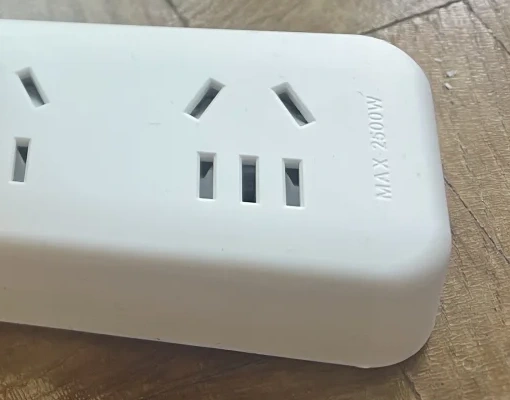
The real power-strip photograph below shows both patterns in one combined outlet. The two outer parallel vertical slots take the two flat pins associated with Type A. The two sloping slots and the centre vertical slot form the three-contact Type I arrangement. The centre slot belongs to the three-pin arrangement; the two outer vertical slots are the separate two-pin pattern.
This is why a country name on a travel adapter is only a starting point. The outlet you actually have, the plug on your charger and the electrical rating all matter. A two-flat-pin plug can resemble a plug used in a lower-voltage country while the Chinese socket still supplies 220 V.
The picture is a close-up of the empty outlet, rather than a recommendation for the other equipment in the original post. This guide covers mainland China; a Hong Kong or Macau stop needs its own adapter check.
Find INPUT or 输入 on your own charger
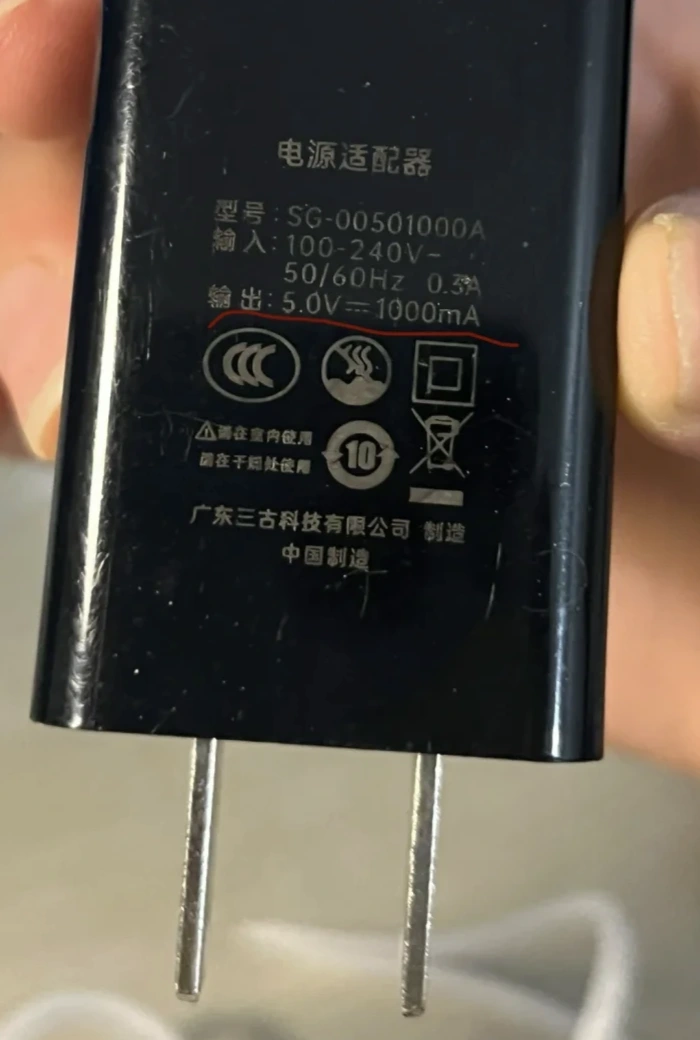
The first useful line on a charger is INPUT, sometimes written 输入 / shūrù. It describes the electricity the charger accepts from the wall.
In this close-up, the black adapter reads 输入: 100–240 V~, followed by 50/60 Hz, 0.3 A. China’s 220 V is inside that printed voltage range, and 50 Hz is one of the stated frequencies. The label therefore answers the voltage-and-frequency part of the question for that unit. The plug shape still needs a separate check.
The line underneath says 输出: 5.0 V, 1000 mA. That is the output to the connected device. It is not the voltage required at the hotel socket.
There is also a square inside a square to the right of the other symbols. Electrical Safety First identifies this as the double-insulated / Class II symbol. It helps explain the equipment’s insulation design; a pair of pins or a low wattage alone does not provide that information.
Your own unit’s label is the one that decides your case. A photograph of another charger, even one from the same brand, cannot replace the specifications of the model in your bag.
Several USB output voltages do not change the wall-input check
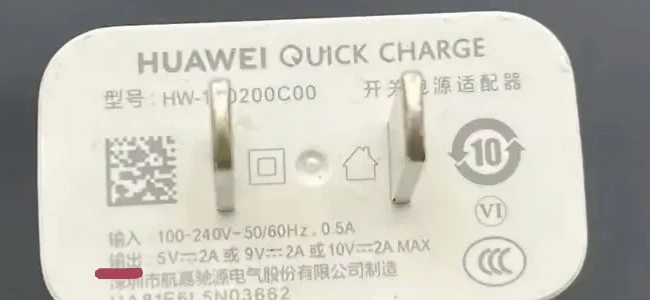
Some charger labels contain a row of numbers that looks much more complicated. The Huawei-labelled charger below has 输入 100–240 V~ 50/60 Hz, 0.5 A, followed by output entries for 5 V, 9 V and 10 V.
For the question “Can this charger accept mainland-China mains electricity?”, the relevant line is still INPUT / 输入. The lower output entries describe what the charger can supply through its device connection under its supported charging arrangements.
The presence of a 9 V or 10 V output does not mean a Chinese hotel needs to provide that voltage. Nor does the INPUT line alone establish compatibility between every USB device, cable and charging protocol. Those are separate specifications.
Manufacturer information is useful when the printing is difficult to read. For example, Apple’s adapter guide gives a 100–240 V, 50–60 Hz range for its genuine power adapters and explains the role of its regional plugs. That statement applies to the manufacturer’s equipment; it is not evidence that every charger has the same input range.
A charger can suit China without being worldwide voltage
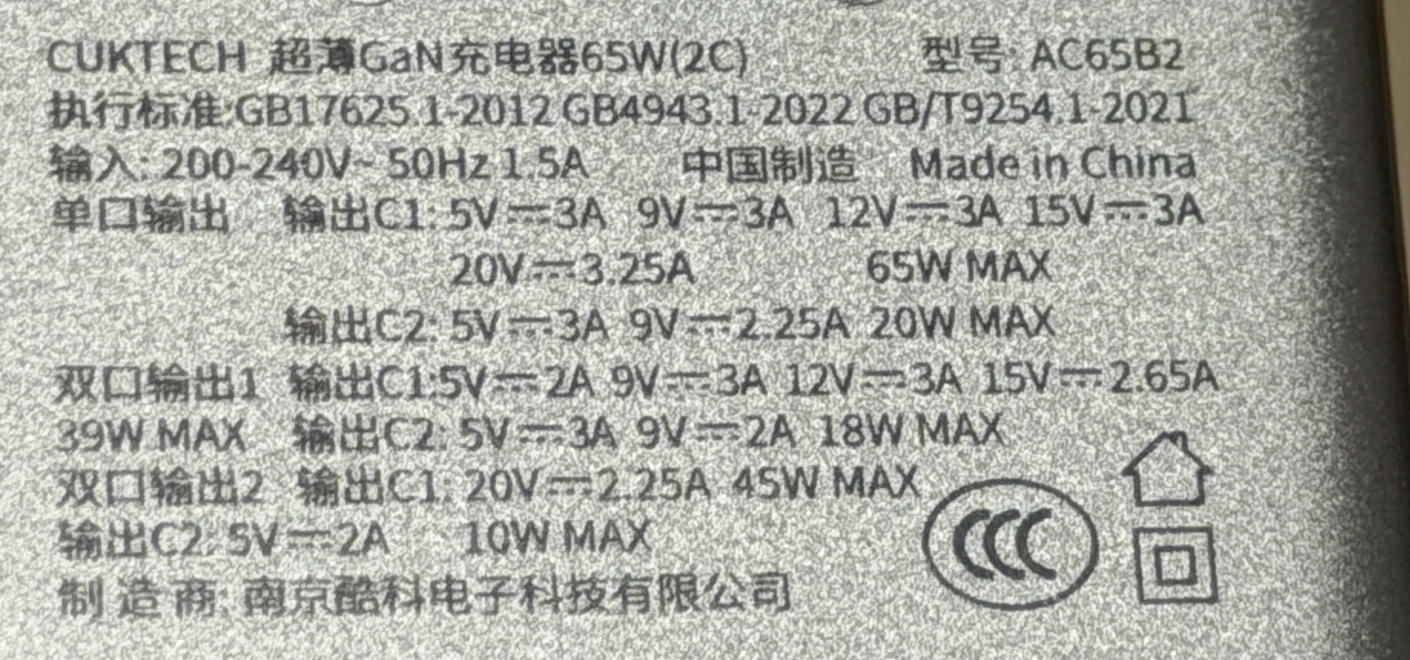
Here is a useful counterexample to the idea that every modern charger is automatically “100–240 V.” The photographed CUKTECH AC65B2 label says 输入: 200–240 V~, 50 Hz, 1.5 A.
China’s nominal 220 V, 50 Hz falls within those printed values. However, the same label does not state support for 100 V or 120 V. A traveller’s account that the charger happened to work elsewhere would not expand its manufacturer-marked range.
The useful question is therefore “Does the stated input include the supply where I am going?”, rather than “Does it say the familiar 100–240 V?” Both this 200–240 V example and the earlier 100–240 V example include 220 V; their suitability for other countries differs.
For an appliance marked only for a supply that excludes 220 V, a plug adapter cannot settle the voltage mismatch. The China electrical-travel guide treats voltage conversion and physical plug adaptation as different functions. A label-reading example is not a recommendation to use a converter with an unspecified appliance.
Compare the metal pins with the actual socket
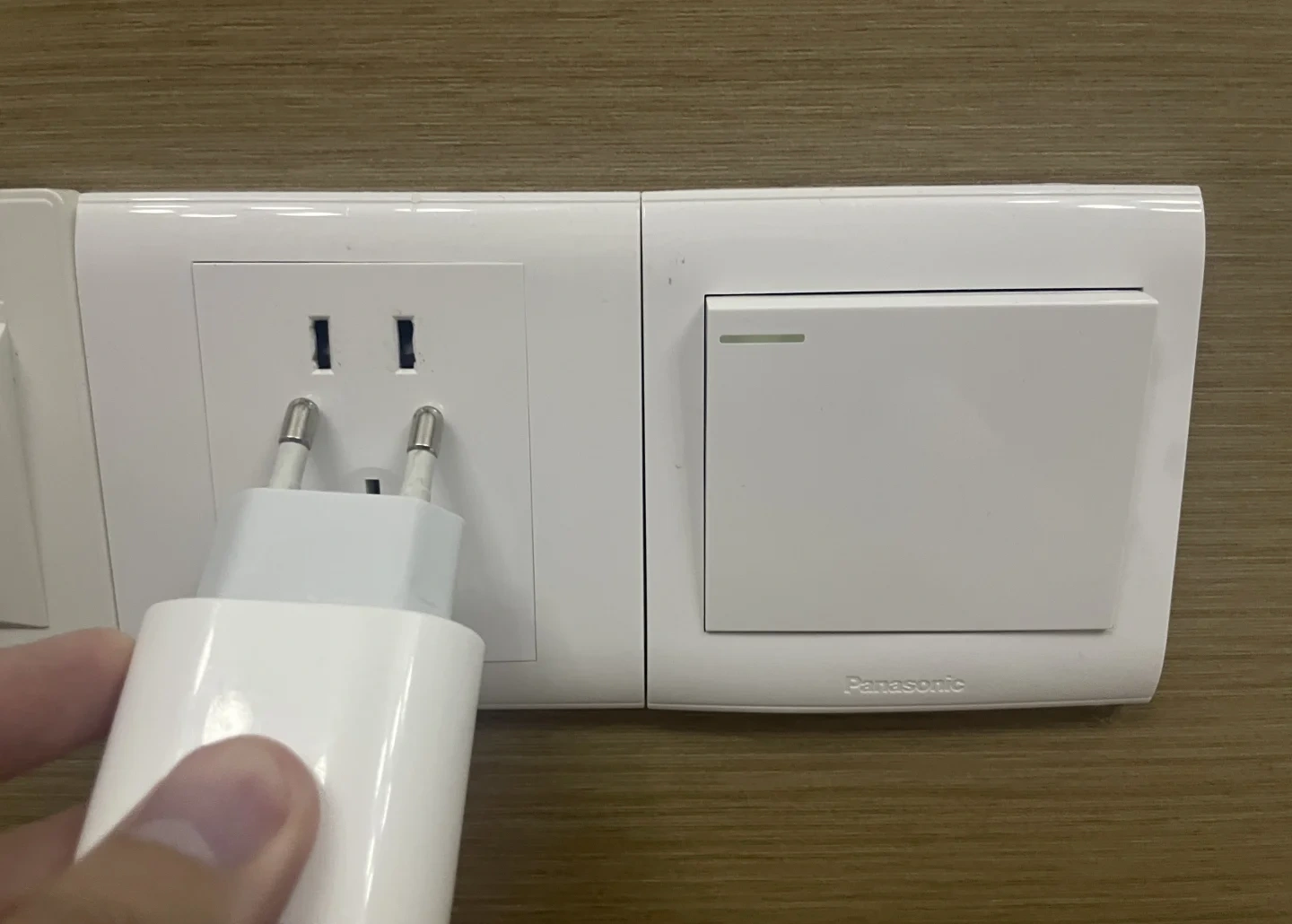
Electrical ratings and mechanical fit are separate. In this photograph, a traveller holds a two-round-pin charger in front of a wall outlet whose upper pair of slots is flat and parallel. The two shapes do not line up.
The question appears repeatedly in travel posts: “Will my European or Korean charger fit?” A country list is not enough to answer it. Electrical Safety First associates Types A, C and I with China, but that does not make a round-pin plug compatible with every socket in every Chinese room.
The comparison is between your charger’s actual pins and the available outlet. For this pictured combination, an appropriately specified adapter would be needed to resolve the shape mismatch. A different outlet may have different accepted shapes.
A close physical resemblance also leaves the voltage and earthing questions open. In particular, a two-pin outlet does not acquire an earth connection merely because an adapter has a receptacle with three holes.
Check both sides of the adapter, including its China-facing pins
An adapter has two different jobs at its two ends: accept your equipment’s plug and fit the destination socket. The holes on its front tell only half the story.
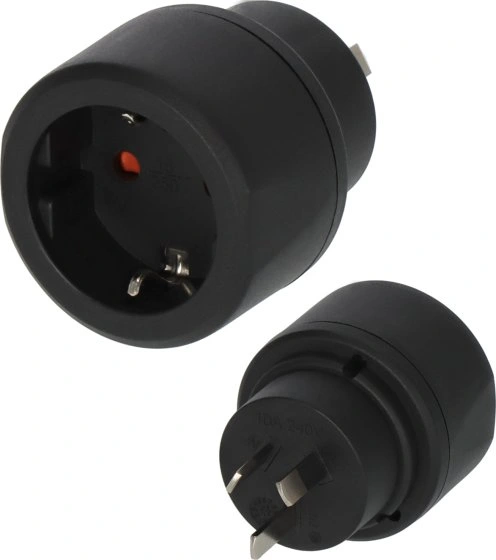
The manufacturer photograph below shows both ends of one specific example, brennenstuhl 1508440. The circular face accepts the stated Type F protective-contact plug system. The other view shows Type I wall-facing pins: two angled flat pins and a third flat earth pin.
The manufacturer’s specification explicitly identifies that wall-side system as Type I (CN). It is an example for understanding adapter direction, not a universal recommendation for a UK, US or any other plug on the incoming side. A Type F receptacle does not become a Type G receptacle because both can involve earthing.
For your own adapter, the destination designation, the actual outgoing pins and the incoming plug compatibility need to describe the same arrangement. The manufacturer also states that this model is not a voltage or frequency converter.
A universal-looking face still leaves important questions open
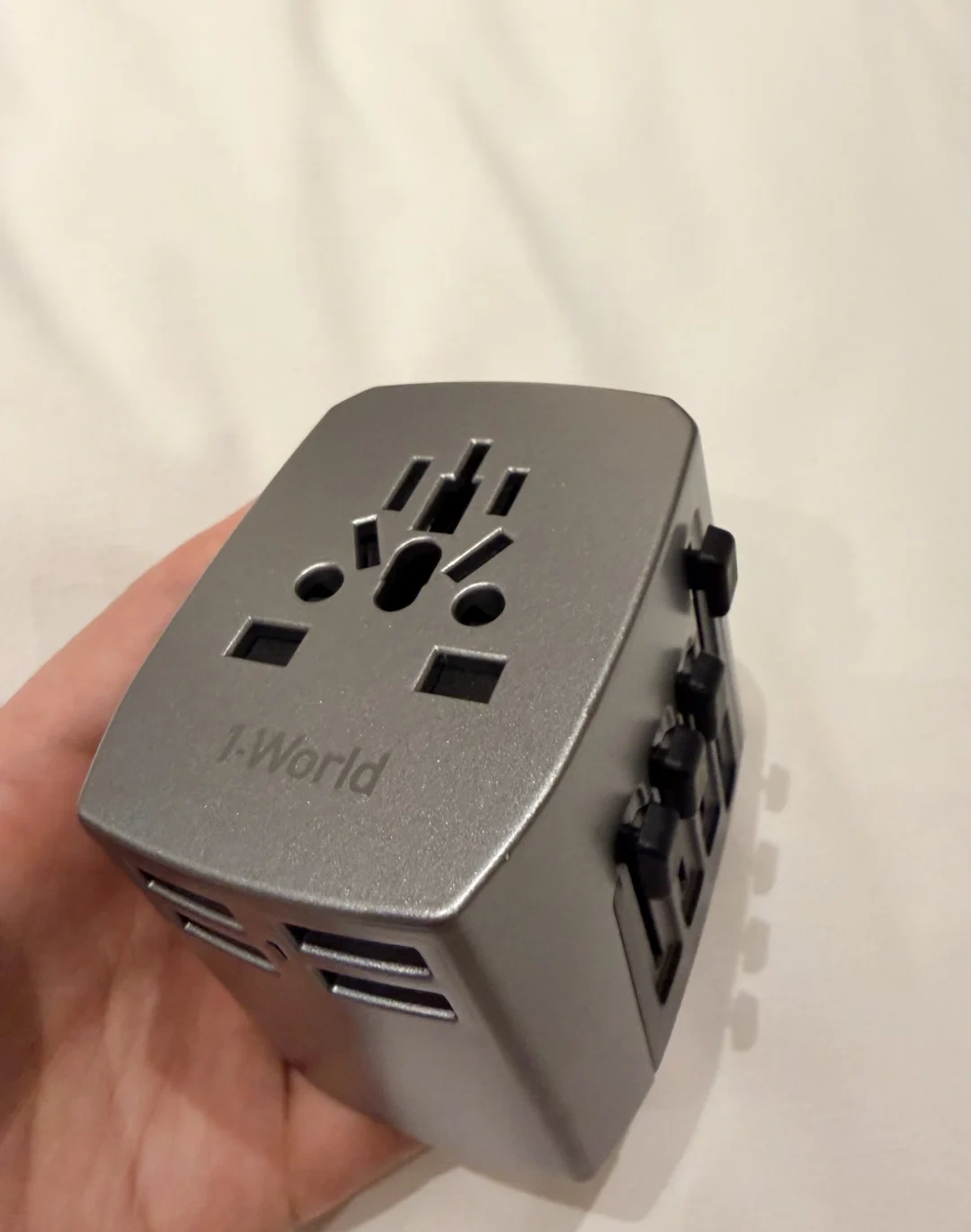
The grey travel adapter below has a front face with several differently shaped openings, plus USB ports along its edge. It looks more accommodating than a simple one-country adapter.
Those openings show where an equipment plug might fit. They do not, by themselves, establish which pins extend from the wall side, whether earth continuity is provided, or what load is permitted. The USB ports also have their own output specification, separate from the AC receptacle.
This distinction matters when comparing products. A large “world travel” label and many front openings cannot answer the compatibility questions established above. The next photograph is the reverse of this same unit, where the restrictions are printed.
For a charger whose manufacturer already confirms the correct input range, the remaining selection still depends on its plug and any earthing requirement. A laptop charger is not automatically suitable for an unearthed adapter simply because its wattage seems small.
Finish with the adapter’s load, conversion and earthing limits
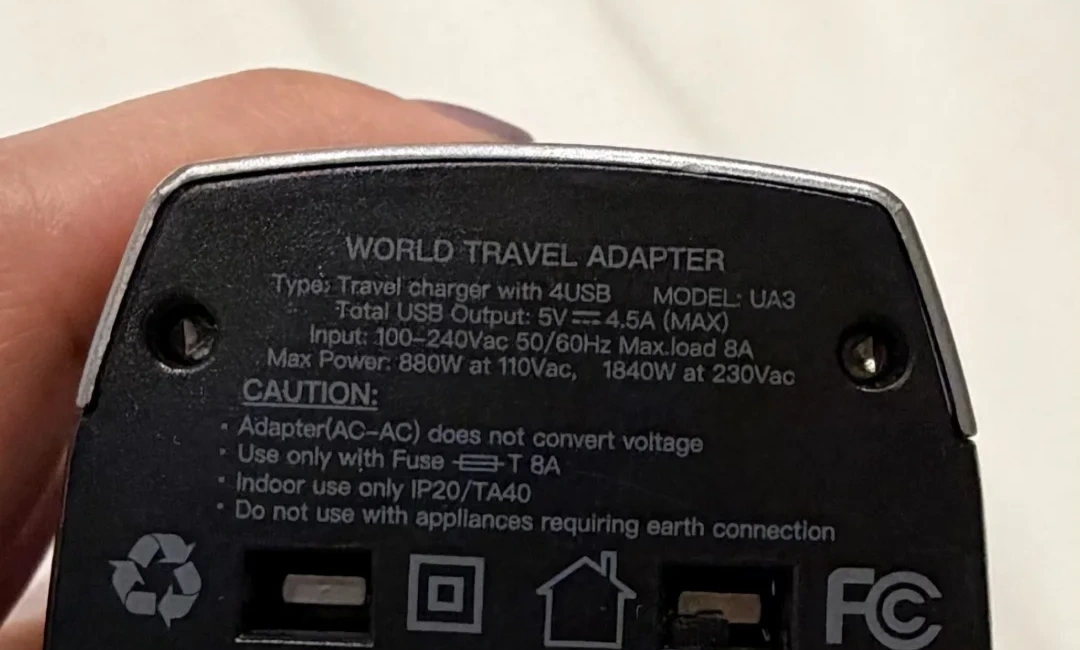
The reverse label of that same UA3 unit gives the missing information. It states 100–240 Vac, 50/60 Hz, maximum load 8 A, separately from total USB output 5 V, 4.5 A maximum. The USB output figure is not an allowance for the AC socket.
Two other printed statements matter just as much as the numbers. The label says that the AC-to-AC adapter does not convert voltage, and that it must not be used with appliances requiring an earth connection. A broad-looking incoming socket has not provided an earth connection for this unit.
Electrical Safety First’s adapter advice distinguishes double-insulated equipment from equipment requiring earth and requires the appliance load to stay within the adapter’s rating. Hong Kong’s Electrical and Mechanical Services Department gives the same practical distinction for two-pin adapters and equipment needing an earth connection. Its advice is used here for the electrical principle, rather than as a statement of mainland law.
The selection is complete only when all four parts agree: the equipment’s input includes 220 V and 50 Hz; its plug matches the adapter’s incoming side; the adapter’s outgoing side suits the intended mainland socket; and its earthing arrangement and load rating suit the equipment. An unreadable or missing specification leaves that choice unresolved. The pictured labels are worked examples, not a certification of the individual products.
A complete example: when this charger needs no shape adapter
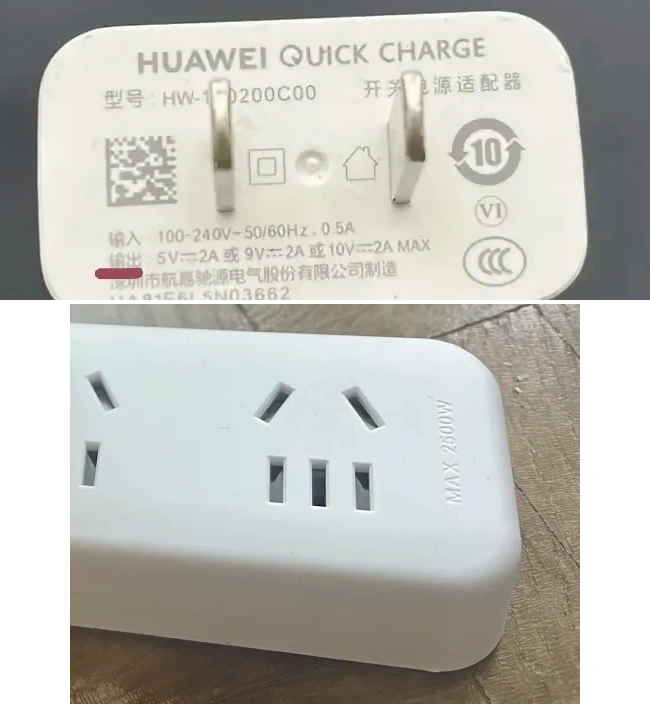
The two photographs below bring the checks together. They show the Huawei-labelled charger from the earlier INPUT example and the empty combined outlet from the first section. They are separate source photographs placed together for comparison.
Supply: the charger’s printed 100–240 V~, 50/60 Hz input includes mainland China’s nominal 220 V, 50 Hz.
Shape: the charger has two parallel flat pins. The outlet has the matching two-parallel-slot pattern: the two outer vertical openings. The angled openings belong to the separate Type I arrangement.
Insulation: the charger label has the square-within-a-square Class II symbol between its pins. This is the pictured example of double-insulated equipment, rather than an earth-required appliance losing its earth through a two-pin adapter.
Selection result: for a charger with these stated specifications and this matching socket pattern, no plug-shape adapter is needed. There is no intermediate travel adapter whose no-earth warning or AC load limit must be accommodated. The charger and the outlet still have their own ratings and condition requirements; the source photos are not an electrical inspection.
If your charger has round pins, a different input range or an earth requirement, that conclusion does not transfer to it. Its own ratings and the appropriate adapter specification determine the answer. This comparison completes the packing decision; it does not claim that these separately photographed items were connected or tested together.
A China adapter is the right choice when its specification matches your actual equipment and destination socket. The photographs give you the details to identify: INPUT voltage and frequency, incoming plug shape, outgoing wall pins, earthing and rated load. The equipment’s output voltage is a separate specification.
Checked 19 November 2026 against the linked aviation, electrical-safety and manufacturer sources. Device and socket photographs are credited to the posts that shared them; the two-ended Type I example is the manufacturer’s photograph. Labels illustrate how to read ratings and do not independently authenticate or certify the pictured products.


Questions and updates
Comments may be reviewed before they appear.
Your comment and chosen name may be published. We store your IP address and browser details to help moderate comments.