
China High-Speed Train Baggage Allowance: Size, Weight and Storage
For a domestic mainland high-speed train trip, ordinary adult travellers have a 20 kg total free carry-on allowance. Each item’s outside length + width + height must not exceed 130 cm. You remain responsible for the bags you keep with you.
There are three separate questions: whether the bag meets the allowance, whether it can sit appropriately in the actual train’s storage, and whether you need a separately arranged consignment or delivery service.
The distinctions that matter before packing
- Ordinary adult carry-on
- 20 kg total, with each individual item also at most 20 kg.
- EMU item size
- Outside length + width + height ≤ 130 cm; a nominal suitcase “inch size” is not the rule.
- Storage space
- Use the actual designated rack or cabinet; an empty bay is not reserved.
- Checked baggage or delivery
- A separate arrangement, with applicable service and charges.
The current allowance, storage photographs and checked-baggage distinction answer those questions in order. The official 12306 rules are the source for the weight and size limits.
Understand the 20 kg total and the 130 cm size limit
For ordinary adult travellers, Article 57 gives a 20 kg total free carry-on allowance, about 44 lb. It also limits each individual item to 20 kg.
On EMU/high-speed trains, an item’s outside length + width + height must not exceed 130 cm, about 51.2 inches in total.
That is a sum of three outside measurements, rather than a suitcase’s advertised “inch size”. For example, 65 + 40 + 25 = 130 cm. This is an arithmetic example, not a measurement of a suitcase in a photograph.
The ordinary 20 kg is a per-person total: two bags do not create two separate 20 kg allowances. The rule separately lists 10 kg for children covered by the child/free-child ticket conditions and 35 kg for diplomatic personnel.
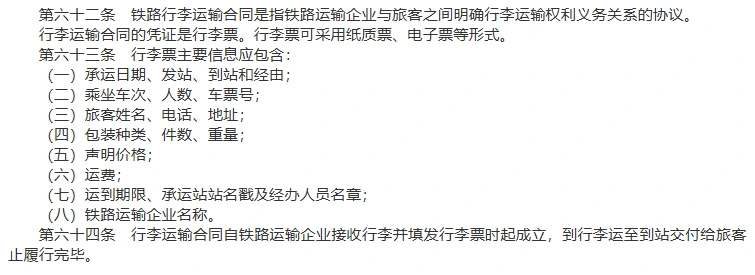
The current rule shown below took effect on 1 June 2026. The 160 cm figure in the Chinese paragraph concerns the general limit before its more restrictive EMU provision; the high-speed-train figure is 130 cm.

Formal checked baggage needs a separate arrangement
The railway rules have a separate chapter for 行李运输, baggage consignment. It provides for a 行李票, baggage ticket, with a freight-charge field and a separate baggage transport contract.
That distinction matters when searching for “checked luggage”. A bag you keep with you and put in a rack remains your responsibility; it has not become checked baggage simply because it is away from your seat.
A formal consignment or delivery service needs its own applicable service and arrangements. The rules do not mean that every high-speed departure offers an airline-style bag drop.
If a bag exceeds the carry-on rules, an account saying “I brought mine without being checked” is not a dependable alternative. Article 59 allows refusal at the departure station; later charge provisions are not a promise of boarding.
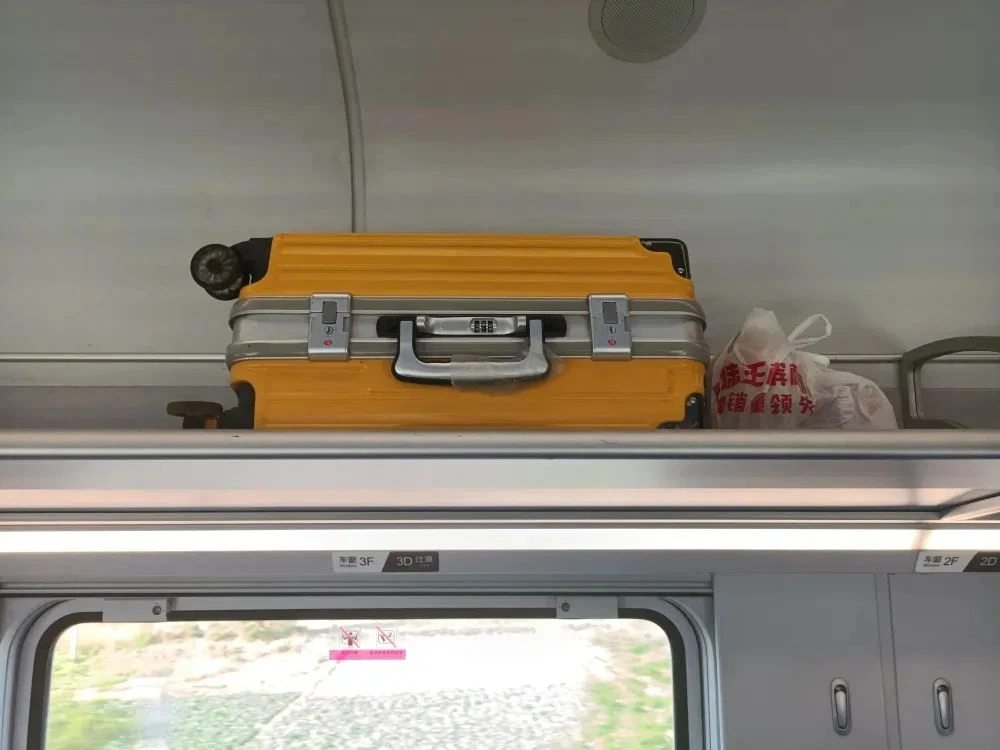
Recognise the overhead rack and a case that stays within it
The long shelf above the seats is the overhead luggage rack. China Railway’s illustrated guidance uses it for medium and small cases, travel bags and backpacks.
In this example, the yellow case lies along the shelf, behind the outer rail. Its contents are not piled into a second layer above it.
This is the useful visual check: the bag belongs within the supported storage space. A statement that “24-inch cases fit” cannot establish that every case of that label fits every train model.
The seller account we read also acknowledges that train models differ. The official photograph shows one layout; the fit of the actual case and rack still matters.
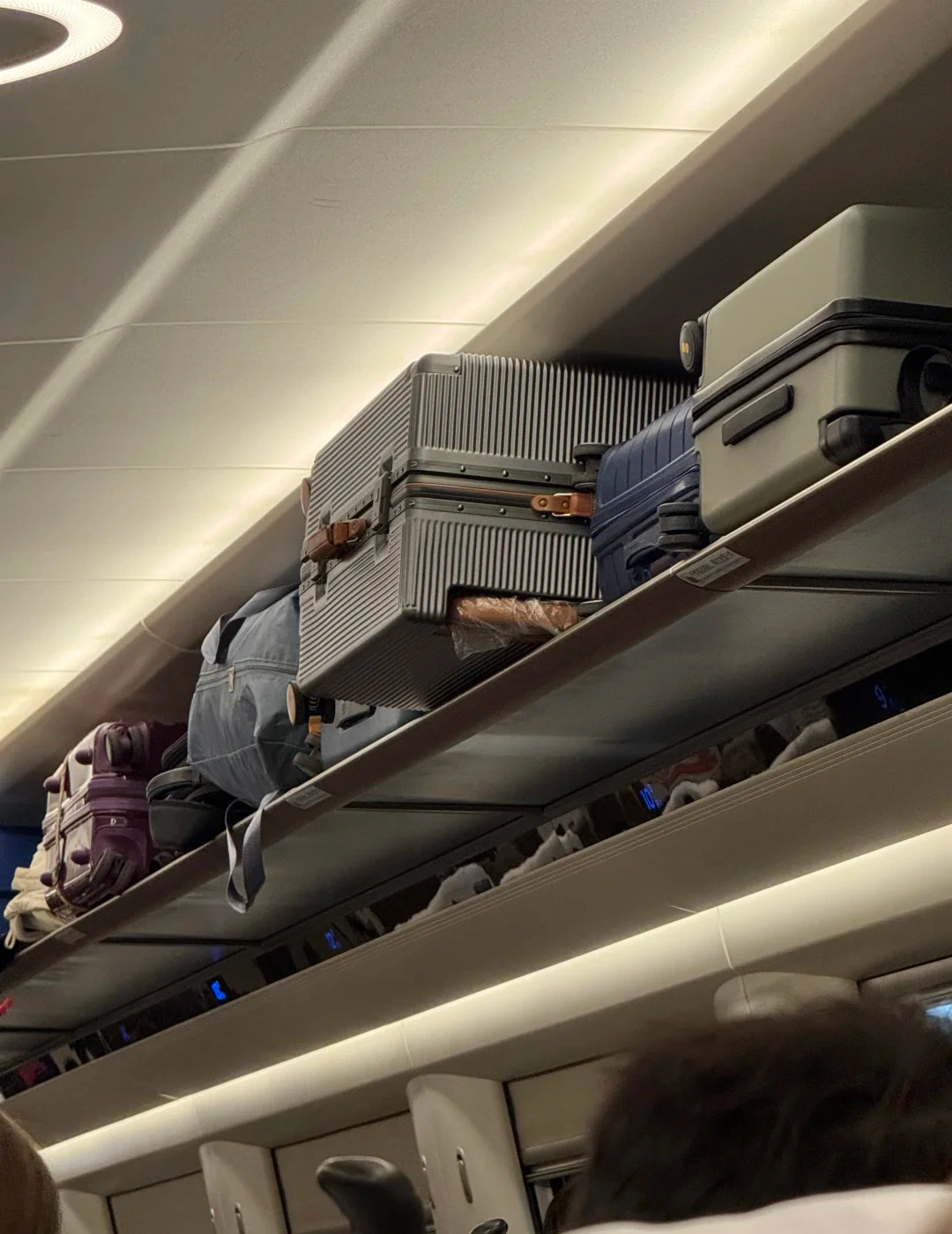
Do not copy a case protruding over the edge
This traveller’s photograph shows why “it is already up there” is not a sufficient test. Large cases extend past the rack’s outer edge.
The author was concerned about the placement. Replies describe differing crew responses; those individual responses do not replace a storage rule.
China Railway’s guidance is clear: items should not extend beyond the rack edge or be stacked. It also calls for stable, secure, orderly placement.
The photograph below is a problem example. It is included so the overhang is easy to recognise, rather than as a technique for making a large case fit.
Recognise a dedicated luggage cabinet or rack
Larger cases belong in the train’s designated large-luggage storage space, when they comply with the carry-on rules and can be stored there appropriately.
The operator’s example below shows a cabinet-style space with a luggage pictogram on the back wall. Other trains use more open shelving; the traveller’s crowded-rack photograph in the next section shows that different form.
The practical distinction is between a space designated for bags and an empty-looking part of the passenger area. A luggage cabinet’s existence does not reserve a space for every traveller’s suitcase.
Neither the photograph nor a case already inside the cabinet proves that another bag meets the 20 kg or 130 cm rules. Allowance and storage fit remain separate decisions.

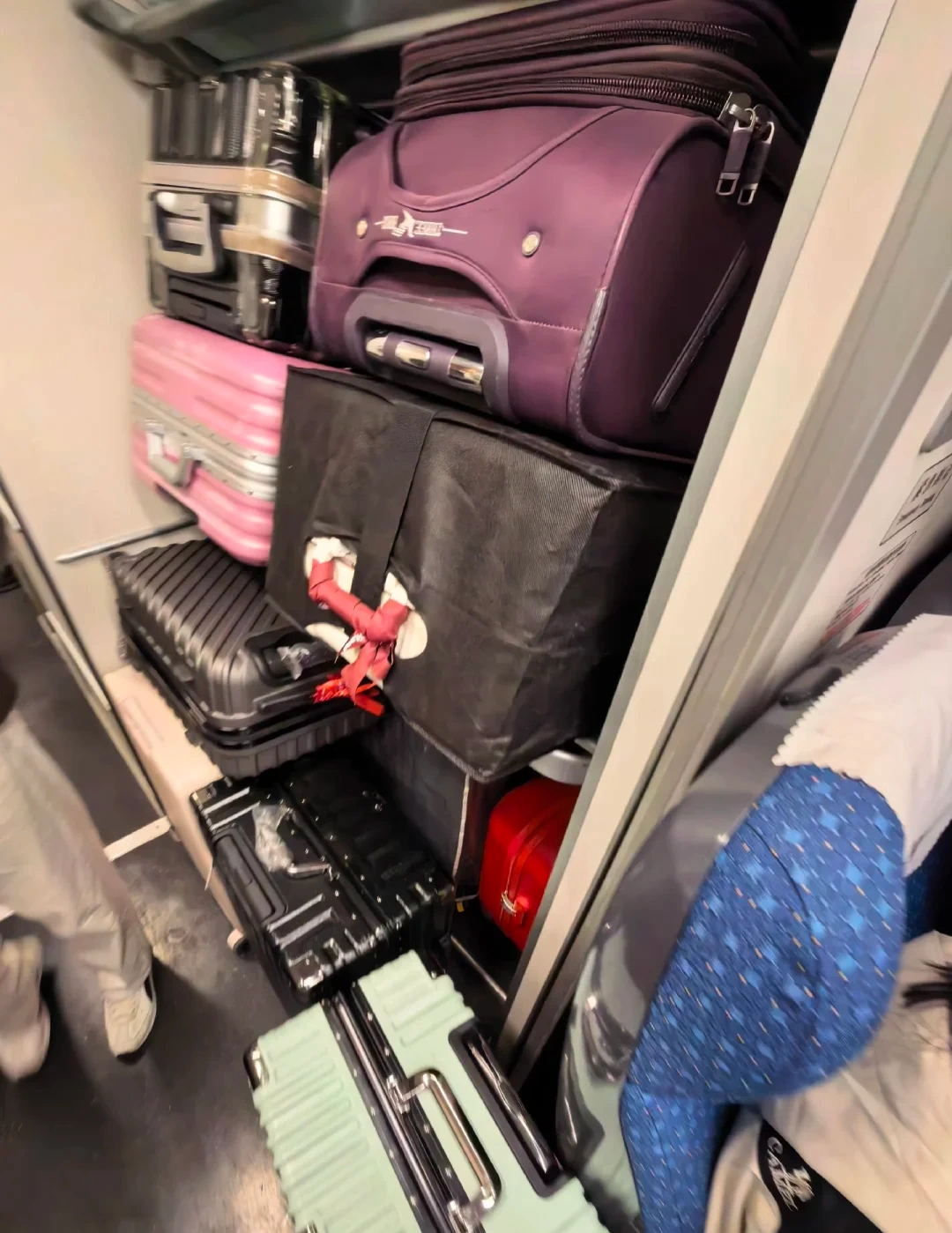
A crowded rack is a problem to resolve with the crew
In this 7 October collection, the dedicated rack is packed and cases also extend onto the floor in front of it.
The writer reports that a crew member later reorganised the luggage. The photograph does not establish which arrangement was approved afterwards, so I would not copy the cases extending into the aisle.
If you cannot identify a suitable permitted space, the next step is to show the case to the train attendant and ask where it can go. A useful sentence is:
这个行李箱可以放在哪里?
Where may I put this suitcase?
It is a request for an appropriate location, not permission to move other passengers’ property or occupy the passage. The available arrangement will depend on the actual train and load. A rack is not guaranteed to be empty when you board.
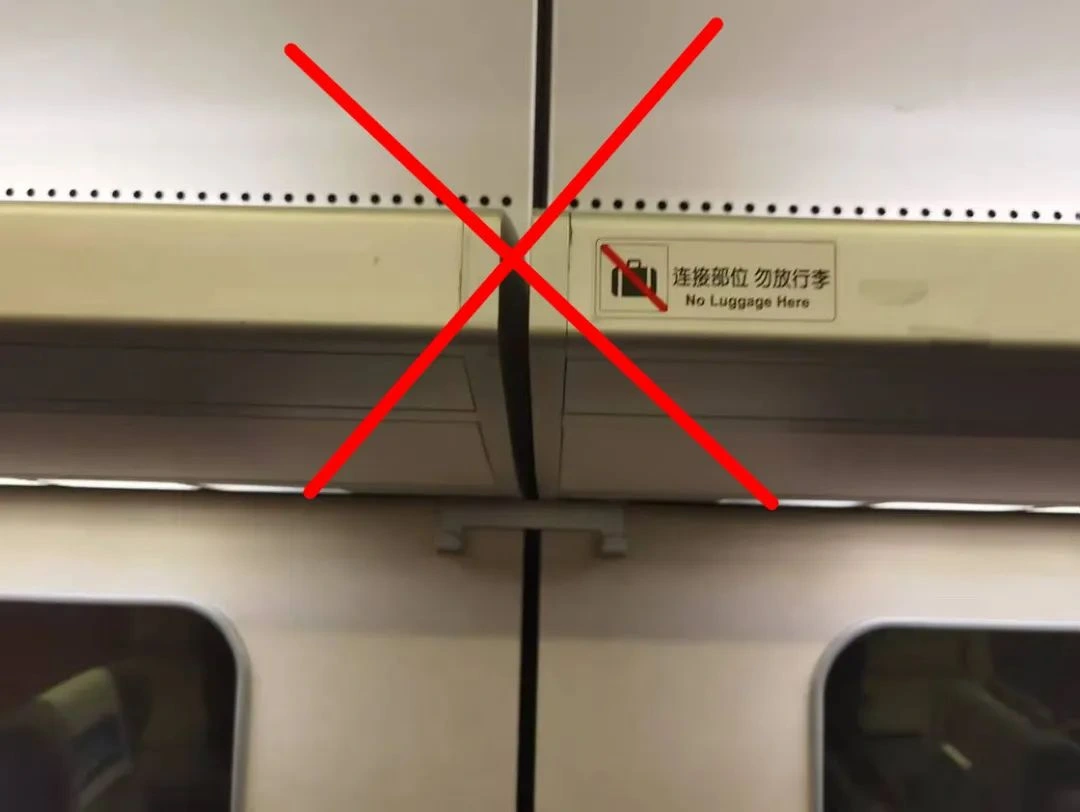
Read the “No Luggage Here” sign at a rack joint
A narrow gap between overhead-rack sections can look like extra capacity.
The operator’s photograph identifies it with 连接部位 勿放行李 and the English wording No Luggage Here. The red cross is part of the original operator guidance.
This is a separate check from whether an item fits inside a normal shelf. A small bag can still be in the wrong place if it sits on a prohibited joint.
The sign gives a clear answer: that gap is not a spare storage position.
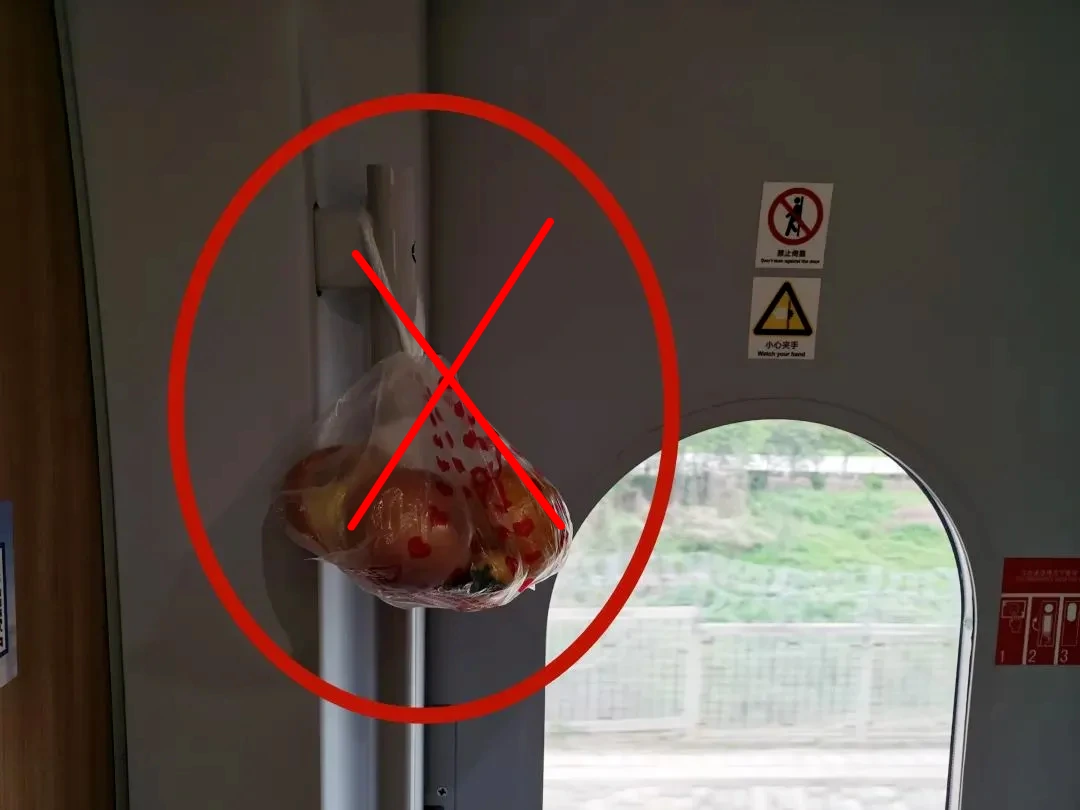
A door handle is not a bag hook
The operator also illustrates a bag hanging from a train door handle and marks it with a red circle and cross.
The accompanying guidance explains that hanging items can interfere with getting on and off the train or catch in the door.
That makes a door handle different from a designated luggage area, even for a light shopping bag. An available handle is not an alternative storage point when racks are crowded.
The photograph below is the operator’s negative example; the original warning marks are retained.
Station-to-door delivery is a separate paid service
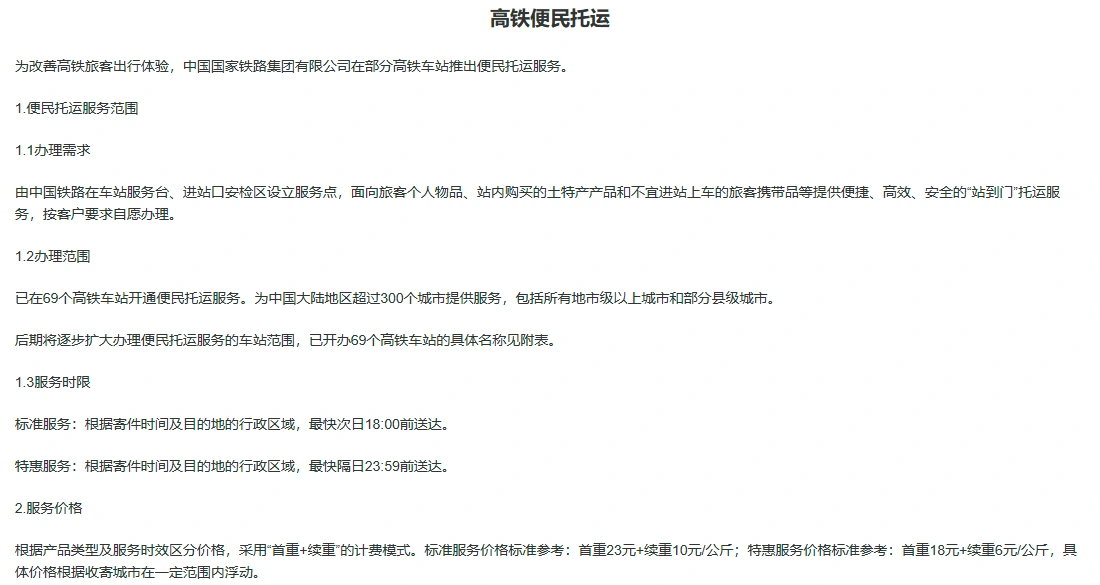
12306 also describes 高铁便民托运, an optional station-to-door service at selected stations.
Its published service description gives next-day delivery at the earliest for the standard service, dependent on dispatch time and destination. Prices vary by product, timing and city.
This is separate delivery, rather than an assurance that the case travels on your train or is ready at your arrival platform.
Use the official service page to check your exact station, accepted identification, delivery date and price with the provider. Passport holders should confirm that the station’s service can process their ID before relying on it.
The useful result is a compliant bag and an appropriate storage plan
Before relying on the train’s free carry-on allowance, the important numbers are the ordinary passenger’s 20 kg total and the 130 cm outside three-dimension sum for each item.
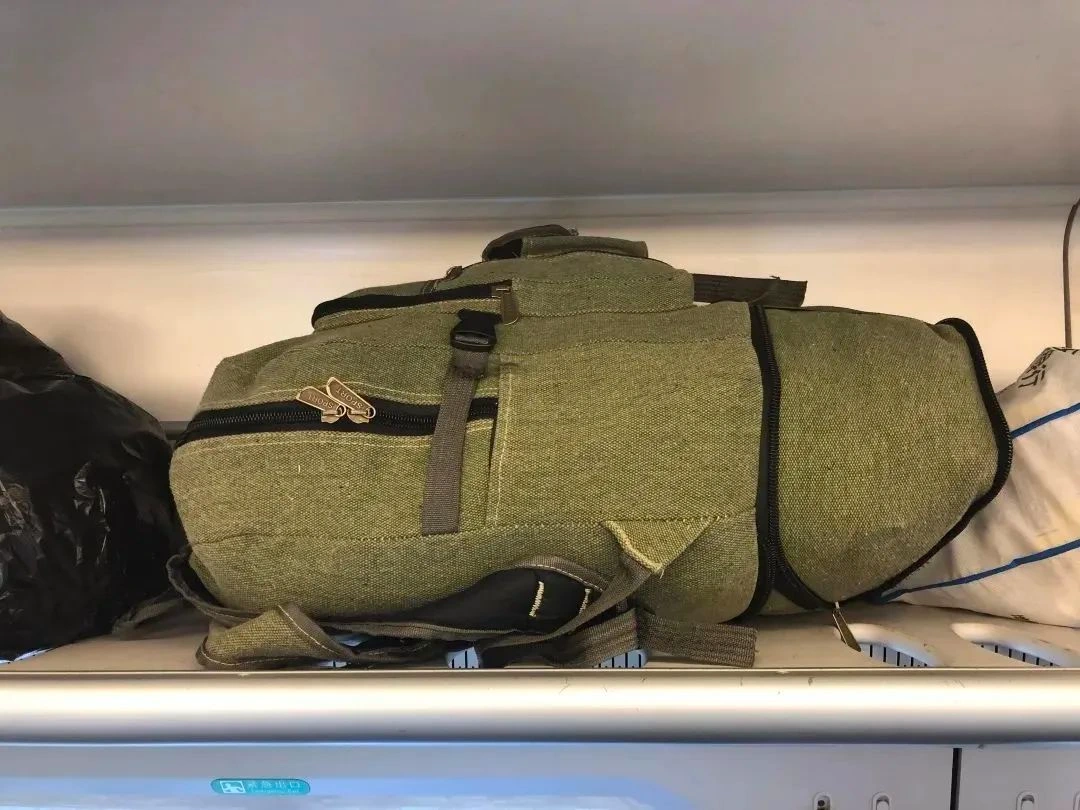
The storage photographs answer a different question: can the bag sit appropriately in a designated area? This compact soft bag is lying flat within the overhead rack.
A sensible plan allows for the actual rack and available space, keeps passages clear, and treats an uncertain location as something for the crew to resolve. A crowded-rack photograph is not evidence that blocking the aisle is acceptable.
If the bag needs separate consignment or delivery, that remains an additional arrangement. A seat ticket and a reassuring comment under a travel post cannot stand in for it.
For ordinary free carry-on, begin with 20 kg per adult in total and a 130 cm outside three-dimension sum for each item. The suitcase label, a photograph of a large case aboard a train, or the size of an empty shelf cannot replace those checks.
The photographs then help you recognise a supported overhead position, a luggage cabinet and placements that should not be copied. If space is uncertain, the crew can identify the appropriate location for that actual train. Separate bag delivery needs its own confirmed service arrangements.
Checked 20 November 2026. The current 12306 rule took effect 1 June 2026. Storage examples are from China Railway’s guide published 24 February 2025 and real visitor accounts; individual photo days are not assumed from post dates. Old restricted-item quantities in the 2025 article are not adopted here. No personal train ride, baggage consignment or foreign-passport delivery booking is claimed.


Questions and updates
Comments may be reviewed before they appear.
Your comment and chosen name may be published. We store your IP address and browser details to help moderate comments.