
Check your entry route before visiting China
Quick answer
Start with the nationality and type printed on your passport, the purpose of your trip and your exact flight or rail route. Check ordinary visa-free entry first. If you need to rely on visa-free transit, verify both mainland ports, your permitted stay area and your confirmed onward destination.
Check National Immigration Administration policiesOn this page
Find the entry rule for your passport and trip
Write down the passport you will actually carry, its expiry, your visit purpose, your first mainland arrival point, your last mainland departure point and every connecting airport. Use the same passport for your bookings and entry paperwork. If travelers in your group hold different passports, check each one separately.
- Look up an ordinary passport waiver. Check the Foreign Ministry’s unilateral visa-waiver FAQ and the mutual exemption guidance. Verify that your passport type, visit purpose and dates match. For example, the Ministry lists UK and Canadian ordinary passports for stays of up to 30 days under its unilateral policy. Check the passport-validity requirement and the stated expiry against your actual dates. Other passports can fall under bilateral rules with different conditions.
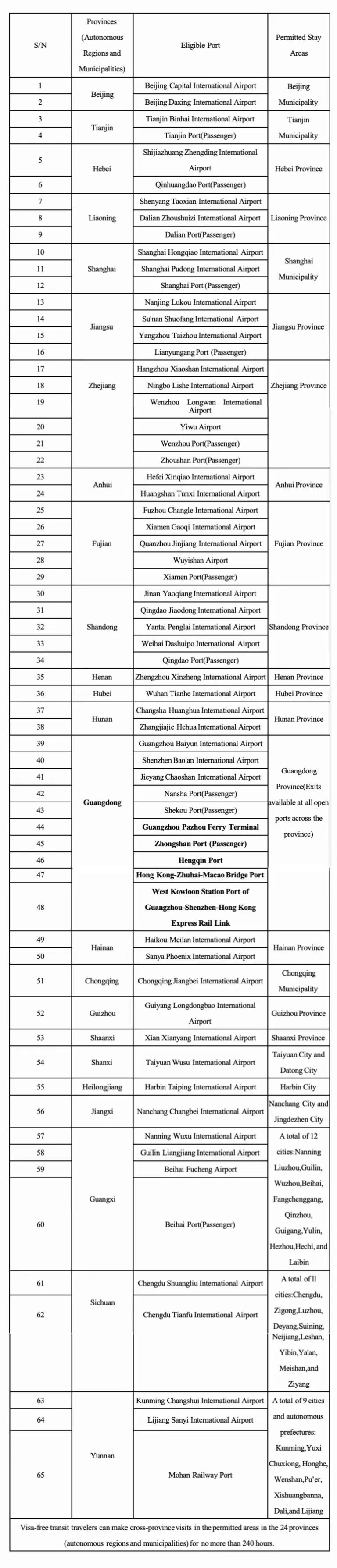
- Check transit if a regular waiver does not cover your plans. The National Immigration Administration publishes separate 24-hour and 240-hour rules. For 240 hours, open the current transit policy for nationality eligibility and the port and stay-area table for the exact airports or stations and places you can visit. The table opens as an image. Zoom in to read the rows for your ports.
- Apply for the appropriate visa when needed. Use the Chinese embassy or consulate responsible for your place of residence to check the correct application channel and timing. Work, study and news reporting may require advance approval or a specific visa. Ordinary tourism is the scope of this guide.
If a holiday booking depends on a specific entry rule, compare the official rule with your exact ticket before you pay for nonrefundable flights or hotels.
Check the route for 240-hour visa-free transit
Read the route as A → mainland China → B. The country or region immediately before the mainland and the first one immediately after it must differ. List actual sectors including connections instead of using the first and last city on a round-trip summary.
- Tokyo → Shanghai → Seoul
- The points on each side differ. Check nationality, ports, stay area and confirmed dates before treating this as eligible.
- Tokyo → Shanghai → Tokyo
- The two sides are the same. Consider an ordinary waiver or visa if you plan to enter under that route.
- Ho Chi Minh City → Shanghai, then Beijing → Hong Kong → Ho Chi Minh City
- Check the Hong Kong sector as the first onward region, confirm the actual itinerary, and verify the permitted mainland route and both ports. Check Hong Kong’s conditions separately if you will go through immigration there.
- Check the passport. The 240-hour route requires an eligible ordinary passport with at least three months of validity, plus permission to enter your next destination.
- Match each port and stop. Use the official table to find your first mainland port, intended exit port and all planned mainland stops. If an itinerary takes you outside your permitted area, resolve that before booking.
- Open the actual onward booking. Verify your name, the confirmed seat and departure date, and the first destination outside mainland China. A proposed trip or waitlist leaves you without the confirmed onward itinerary the official rule requires.
- Work out the last day. Under the published 240-hour rule, counting starts at 00:00 on the day after entry. Ask the inspecting officer to confirm your exact deadline and plan around that deadline.
For a short connection, the separate 24-hour provision covers qualifying through transit. If you need to clear immigration to collect checked bags, change airports or use an outside hotel, ask how to obtain temporary entry permission. Check the airline’s transit hotel and baggage conditions separately before booking.
Prepare the free arrival card and an offline document pack
Use the National Immigration Administration’s official arrival card if you need to submit one. The official service is free. The agency also offers a paper card or in-port devices if you cannot complete it in advance. Travelers in specified exempt categories, such as direct 24-hour transit without leaving the restricted area, may skip the card under the published rules.

- Keep the original passport and, if applicable, valid visa where you can reach them easily.
- Save a copy of your full itinerary showing the booking, onward date, destination, flight or train number and all connecting segments.
- Save your first accommodation address and contact details. Keep any hotel booking offline so you can read it away from airport Wi-Fi.
- On the official site, choose Language at the top right if needed and open the standard arrival declaration. Complete the requested fields using your passport, your actual arrival and onward details, and your accommodation address. Review the entries before submitting. Keep the result the site returns on your phone. If you use a paper card, have it ready to hand over at inspection.
If a layover turns into an overnight stay, make sure the airline can explain whether you need to pass border control to reach the room. A hotel confirmation and permission to enter are separate checks.
At the border and after you reach your accommodation


- At the first mainland port, follow the staffed directions for your entry category. If applying for temporary entry on transit, tell immigration staff which transit route you are using and show the original passport, arrival information and confirmed onward booking together. Completing the arrival card gives the officer your details. The decision to admit you happens at inspection.
- Check the stay deadline or permit details given at inspection. If there is an inconsistency or you are unsure of the departure date, ask at the counter before leaving.
- At a hotel, give reception your original passport and ask them to confirm the accommodation registration. At a private residence, ask your host to help register your stay within 24 hours of arriving. On the NIA platform or the NIA 12367 app or mini program, complete the account and identity check, then use Foreigner Service → Accommodation Registration. Look under Registration Record Inquiry for the completed record. If online registration fails, ask your host to go with you to the local police station or public-security service window within that window.
If an airline changes your destination, connection or date while you are in China on transit permission, ask the airline and China’s immigration service at 12367 about the new itinerary promptly. Keep your original and replacement bookings handy and confirm your options before the permitted stay ends.
How to tell you can finish your entry and arrival paperwork
- Before boarding Each traveler has matched a valid visa or visa-free rule to their passport, purpose, stay and actual route.
- At the border The officer has cleared your entry. If you entered on transit permission, you know the deadline and where you may travel.
- At your accommodation The hotel has registered you, or you and your host can find the completed non-hotel registration record.
If you get stuck. Ask the Chinese consulate or the 12367 immigration service about an uncertain route before committing to nonrefundable travel. At the airport, ask immigration staff before leaving the controlled area.
Sources
- Ministry of Foreign Affairs unilateral visa-waiver FAQ
- Ministry of Foreign Affairs mutual visa exemption list
- National Immigration Administration 24-hour and 240-hour transit rules
- National Immigration Administration · eligible transit ports and permitted areas table
- Beijing government inbound FAQ with examples of itinerary routing
- Beijing government transit eligibility, time calculation and on-site review
- National Immigration Administration official arrival card notice
- National Immigration Administration nationwide accommodation registration
Keep planning
- Itineraries10 days in China: Beijing, Suzhou and ShanghaiA 10-day first trip with four nights in Beijing, five in Shanghai and one Suzhou day trip. Each day has a route and a fallback.
- Internet & eSIMChina eSIM, local SIM or roaming?Check if your phone supports a China travel eSIM, install it on iPhone or Android and keep your home number available for bank texts.
- PaymentsHow to pay in China as a touristDownload Alipay and WeChat, sign up with your overseas number and add a foreign card. See where to tap, how to pay at a shop and what to do if it fails.