
Cash in China: Notes, Coins and Where You Can Pay
Cash remains useful in mainland China, but the payment context matters. If you already have yuan notes or coins, start by identifying the values below. Then compare the kind of transaction with the current cash rules.
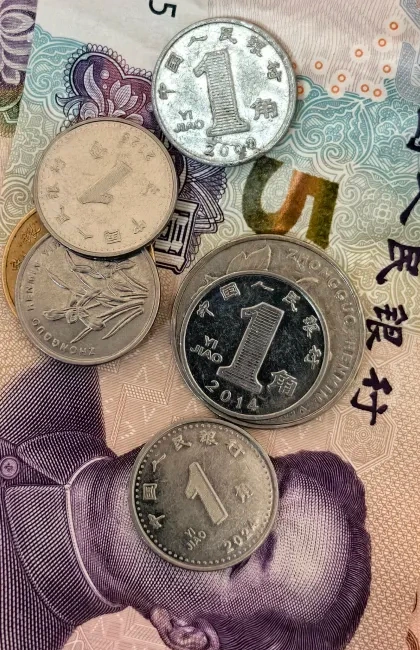
The photographs make two details especially clear: 5 is not 50, and a coin with a large 1 can mean one yuan or one jiao. Those are practical distinctions before you count what is in your hand.
This guide covers banknotes, coins and cash-acceptance contexts. Withdrawing money and completing an app payment are separate tasks.
Recognise the six yuan banknotes in one real photograph
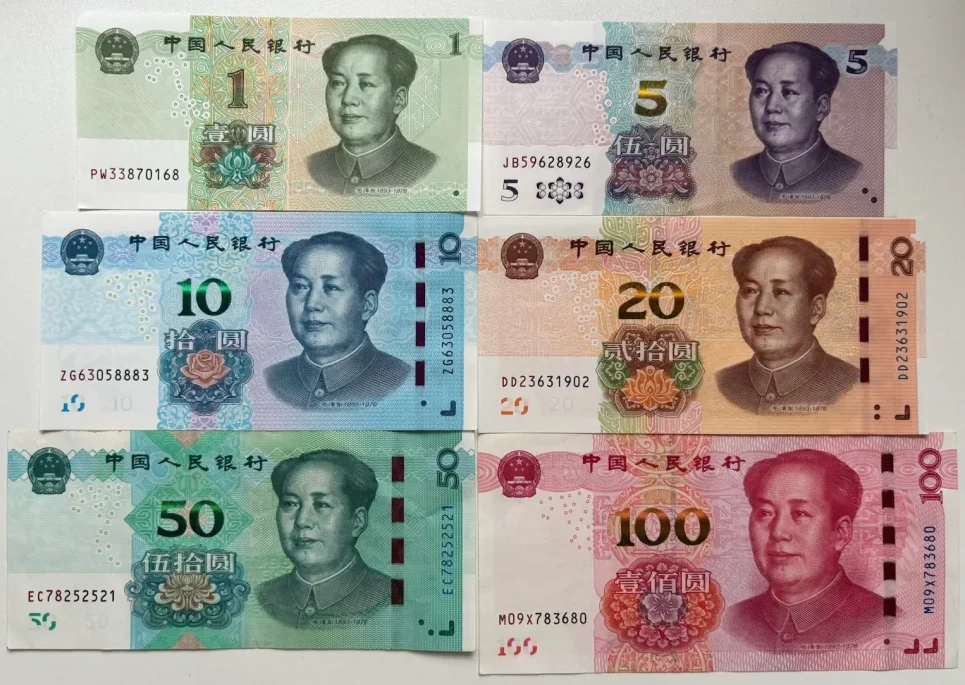
The Shanghai government’s English payment guide lists six banknote denominations: 1, 5, 10, 20, 50 and 100 yuan.
In this collector’s photograph, the first row is ¥1 on the left and ¥5 on the right. The second is ¥10 and ¥20; the bottom row is ¥50 and ¥100.
The large printed numerals provide the quickest comparison. Start at the top and read each pair: 1 / 5 → 10 / 20 → 50 / 100. You now have a visual reference for the full set, rather than trying to remember a colour description.
After the unit explanation, the close-up of 5 and 50 yuan separates two values that are easy to rush past when you are unfamiliar with the currency.
RMB, CNY and yuan: read the unit as well as the number
RMB is short for renminbi, and CNY is the currency code. Yuan / 元 is the main unit. On a mainland price, CNY 5 and 5元 mean five yuan.
The smaller units are jiao / 角 and fen / 分: 1 yuan = 10 jiao = 100 fen. Therefore 1角 = ¥0.10, while 1元 = ¥1.00.
That distinction matters when counting coins: a large “1” on its own is not enough. The Bank of China explanation below gives the same units and conversion; the real coin close-up below shows where to find the characters.

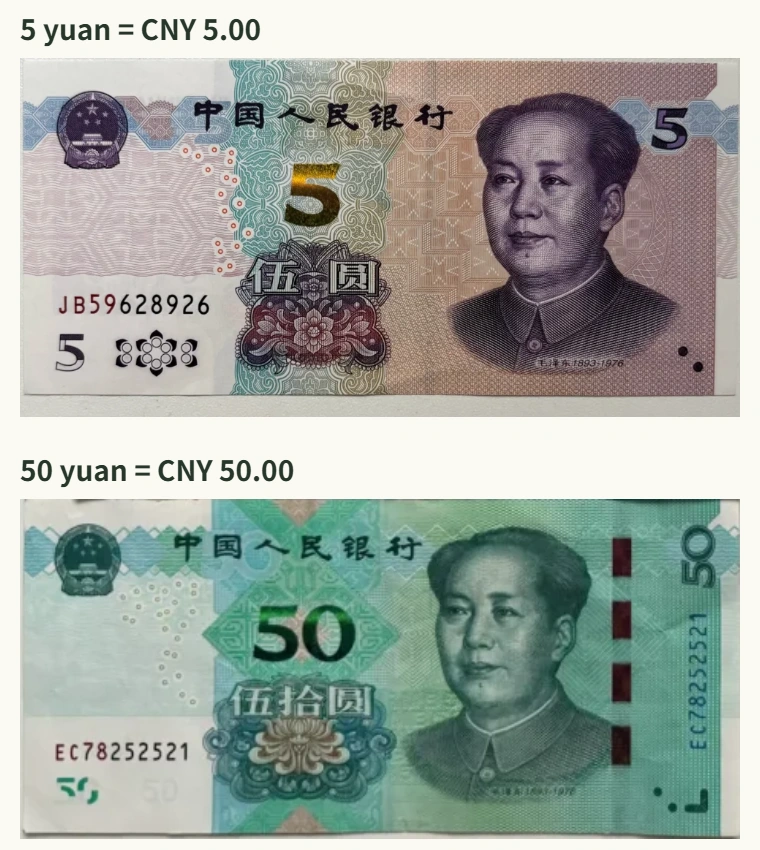
Separate 5 yuan from 50 yuan before counting the total
The first note below has a large 5; the second has 50. Their values are ¥5.00 and ¥50.00, a difference of ¥45.
Read the whole number, including the zero. Colour can help you find a note in the photograph, but the printed value is what determines the arithmetic.
For a simple counting example, one note of each value makes ¥55. Two of the top note make ¥10; two of the bottom note make ¥100. Each result follows from the visible denomination, without assuming anything about a shop price or the change you should receive.
The English labels sit outside the photographs. The banknote printing has been left unchanged.
A coin marked “1” can be one jiao or one yuan
There are three useful examples in this close-up. The bright coin at the top reads 1角: its value is ¥0.10. The dark coin in the middle-right reads 1元: it is ¥1.00. The bottom coin is another 1角, worth ¥0.10.
Those three identified coins total ¥1.20. They do not total three yuan. Other partly visible coins are outside this example.
The shape of the character matters more than the apparent brightness of the metal: 角 means jiao, and 元 means yuan. Both jiao coins in the photograph have the same face value despite their different appearance.
Open the photo larger if needed to read the character beside each “1”. You can confirm the conversion in the Bank of China’s explanation.
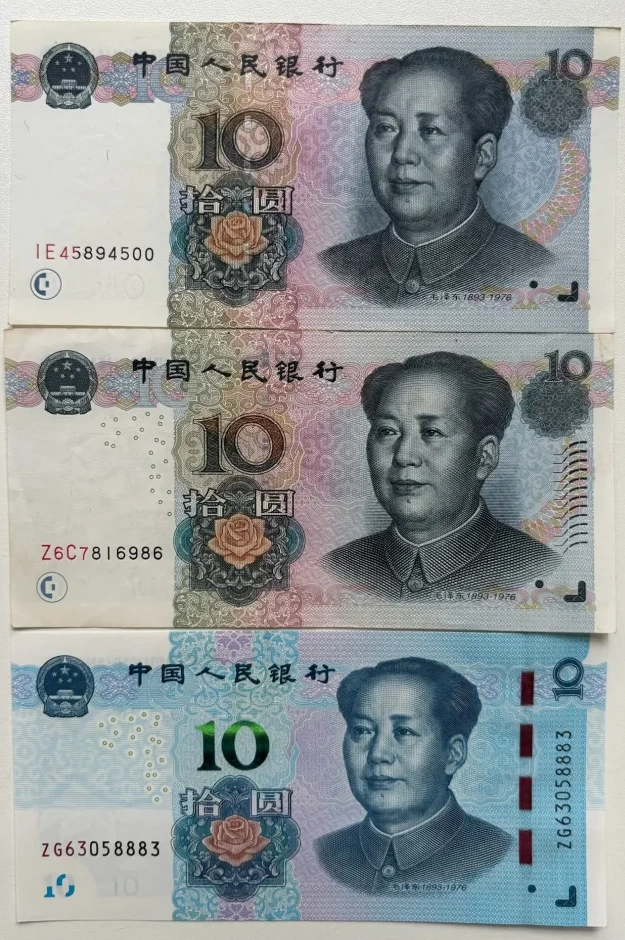
Different-looking notes can carry the same printed value
All three fronts below display 10. The upper two look different from the brighter blue note at the bottom, but the denomination shown on each is ten yuan.
The collector’s original paired front-and-back photographs identify the examples as 1999, 2005 and 2019 editions. Bank of China also explains that the fifth series has been issued in several edition years.
For recognising a value, compare the printed numeral before deciding that a colour difference means a different amount. Three notes displaying ten yuan have a combined face value of ¥30.
A photograph is not an authenticity test. This comparison teaches the displayed denomination; it cannot certify a particular note in your hand, its condition or its acceptance. The Bank of China page links to the central bank’s separate authentication information.
Can you use cash? Start with the type of transaction
Yes: cash remains a payment option in mainland China. Under the rules effective 1 February 2026, staffed collection and face-to-face services must support it, subject to specific statutory requirements for non-cash payment. Online bookings fulfilled offline are also covered where face-to-face collection is possible.
This answers the first worry without requiring you to recognise a payment app. The original Article 4 below identifies those three contexts; the unattended and entirely online cases appear later.

Unattended services need a different cash arrangement
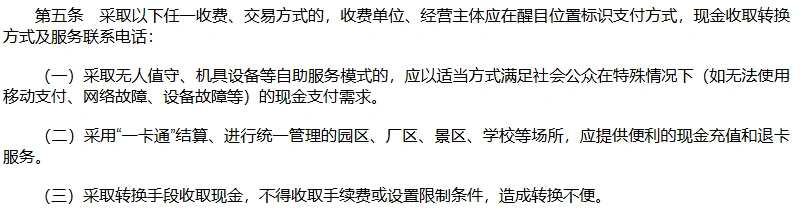
Article 5 requires clear display of payment methods, cash-conversion arrangements and a service contact. Unattended services must make suitable provision for cash needs in special circumstances, including mobile-payment or equipment failure. Cash conversion must not impose extra fees or obstructive conditions.
This does not promise a banknote slot on every machine. The excerpt below is the rule, rather than a photograph of any particular machine’s controls.
Entirely online transactions have their own payment disclosure rule
Where the transaction, payment and service are all completed online, Article 6 requires payment methods to be disclosed in advance and explained during service. It does not create a cash button inside every app.
That is the final distinction: the staffed, unattended and entirely online situations above are different contexts. The recognition examples help with the money itself; this classification helps explain why cash alone does not solve every checkout.
For the separate task of setting up mobile payments, the site’s Alipay and WeChat guide covers that route.

The recognition check: the six note values are 1, 5, 10, 20, 50 and 100 yuan. In the close-ups, the 5 and 50 notes total ¥55; the two 1角 coins and one 1元 coin total ¥1.20.
You can now read the value before counting the total and distinguish the three payment contexts explained above. For a physical note, this visual reference remains separate from checking its authenticity.
Checked 20 November 2026. Real banknote and coin photographs are credited to their source authors. The current cash-rule excerpts took effect on 1 February 2026; the Bank of China explanation is dated 27 August 2025. No purchase, withdrawal or physical visit was performed for this article.


Questions and updates
Comments may be reviewed before they appear.
Your comment and chosen name may be published. We store your IP address and browser details to help moderate comments.