
Best Time to Visit Kunming: Gulls, Jacaranda and the Rainy Season
For general Kunming sightseeing, I would compare March–April and November. For the gulls over Dianchi Lake, I would investigate winter first. For purple jacaranda streets, I would start with late April into mid-May, then refine by the actual year.
Summer is another reasonable choice if you accept more rain: the station’s summer monthly means stay near 20–21°C, while the rainfall increases sharply. Winter offers beautiful lake light, but it is a cool city trip.
Choose by the scene you want
- General city sightseeing
- Compare March–April and November for relatively modest rainfall.
- Gulls over Dianchi Lake
- Investigate November–February, within the broader late-October-to-March season.
- Purple jacaranda trees
- Start with late April into mid-May; bloom progress varies by year and tree.
- Fixed summer dates
- Weigh mild monthly means against much higher rainfall.
The photographs below separate those choices, including a rainy flowering street and an individual late-May tree. The dated urban forecast is the final check for the actual trip.
Choose winter if the gulls are the main reason for coming
For gulls over Dianchi Lake, I would investigate November–February first. That puts a trip inside the broader late-October-to-March season described by the resort authority in a 2 November 2026 report.
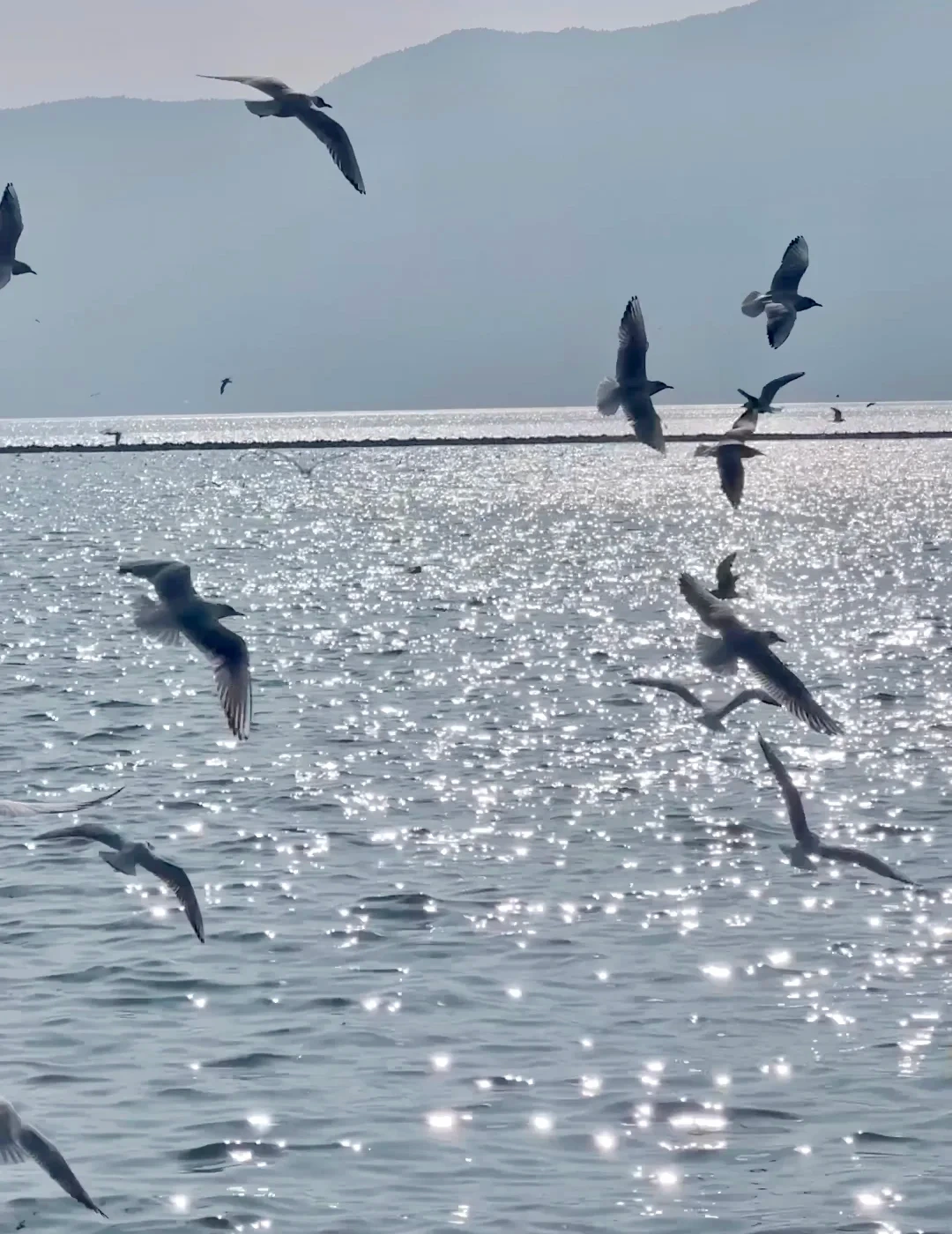
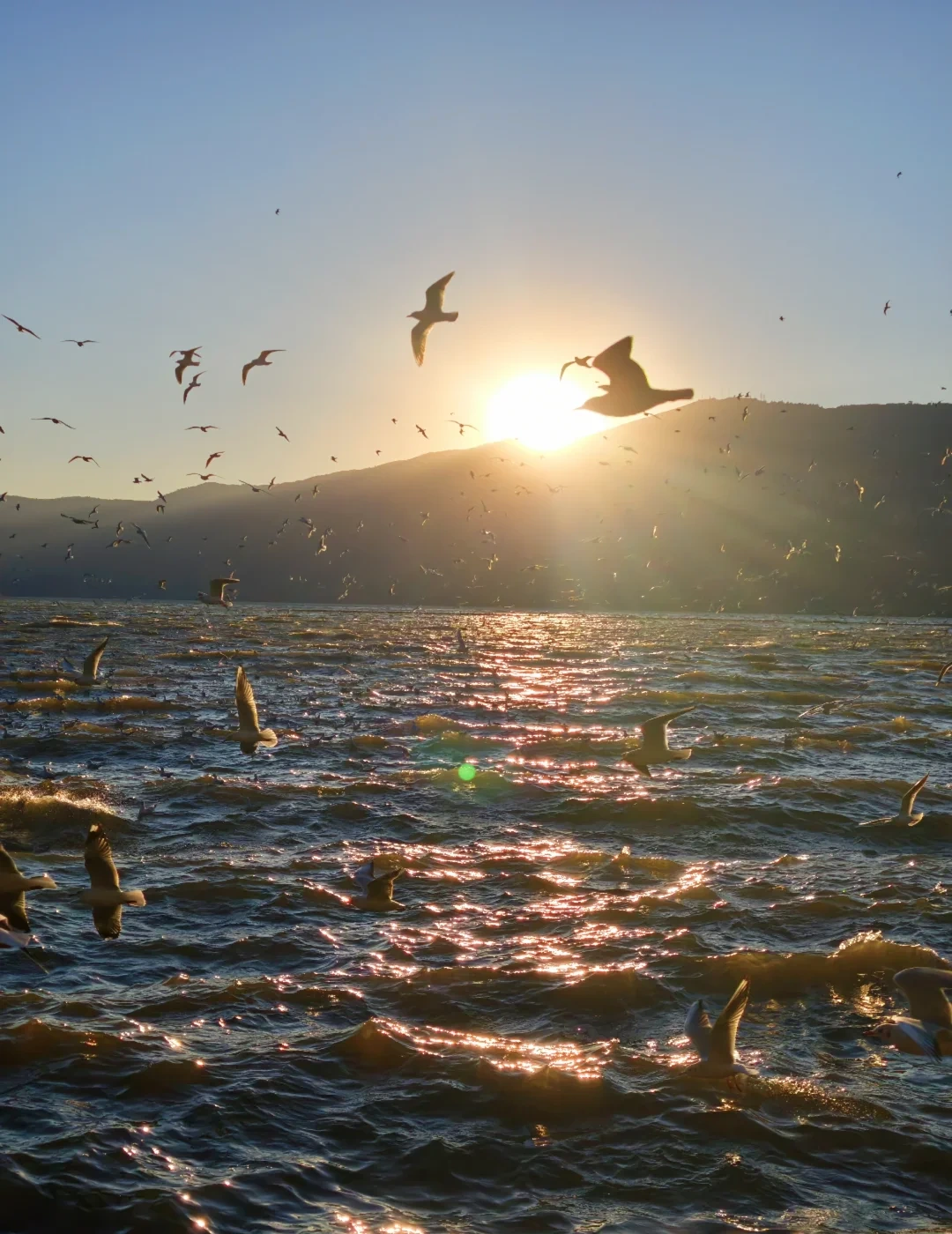
The photograph below is from Haihong Wetland / 海洪湿地, in a November visitor account. Birds cross the glittering water with hills behind them. The author places the first two images at roughly 16:00–17:00.
Recent accounts dated 3 and 19 November also describe gulls at Haihong. Those captions support the November timing, although their videos are not the photograph shown here.
If this is the scene that makes you want to visit, winter deserves priority over a generic spring recommendation. It still takes a real weather window: the November forecast example is overcast, not a promise of this light.
For general sightseeing, compare March–April and November
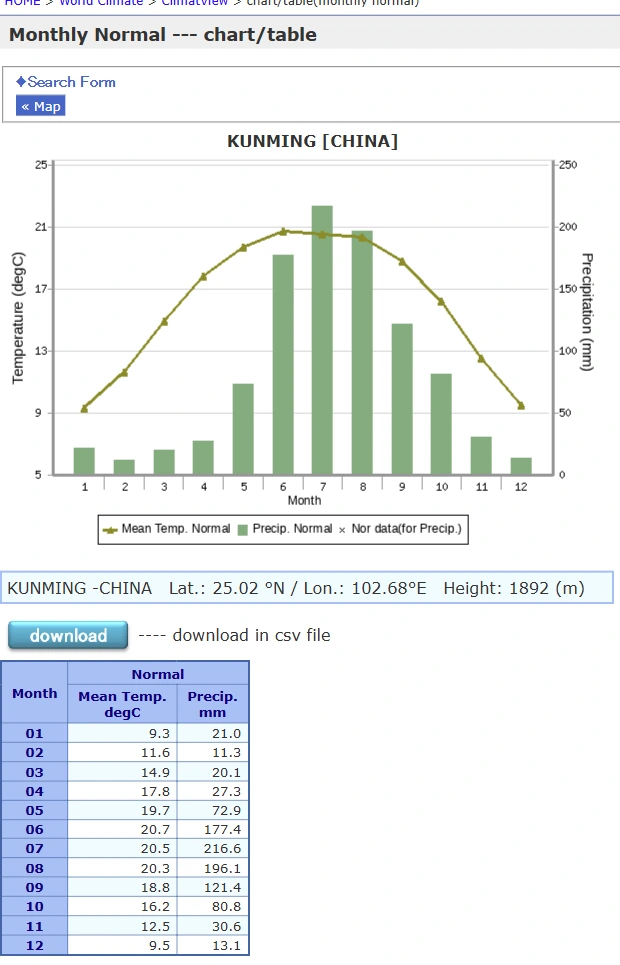
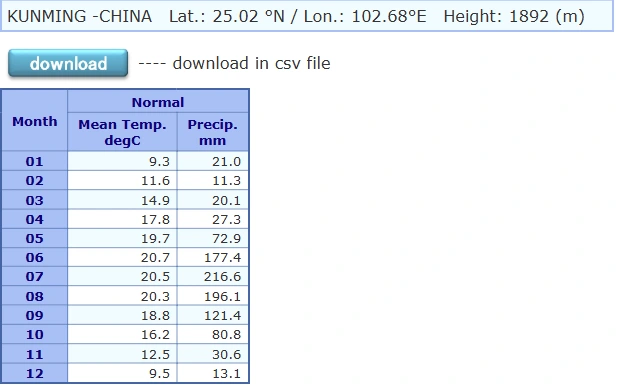
For a city trip without one must-see seasonal spectacle, March–April and November would be my first comparison. The station record combines relatively modest rainfall in these months with mean temperatures of 14.9°C in March, 17.8°C in April and 12.5°C in November.
The Kunming station is at 25.02°N, 102.68°E, 1,892 m. Its monthly means rise to 20.7°C in June, then remain around 20–21°C in July and August. January is 9.3°C and December 9.5°C.
These are 1991–2020 monthly means, including both day and night. An average near 20°C does not make every summer afternoon 20°C, and a winter average near 9°C does not tell you the overnight low for your trip.
Kunming’s city record is also a poor substitute for the weather at a different, higher destination elsewhere in Yunnan.
For purple jacaranda streets, investigate late April into mid-May
If the purple flowers are the point of the trip, the most useful starting window is late April into mid-May. This is a different choice from a general March city break.
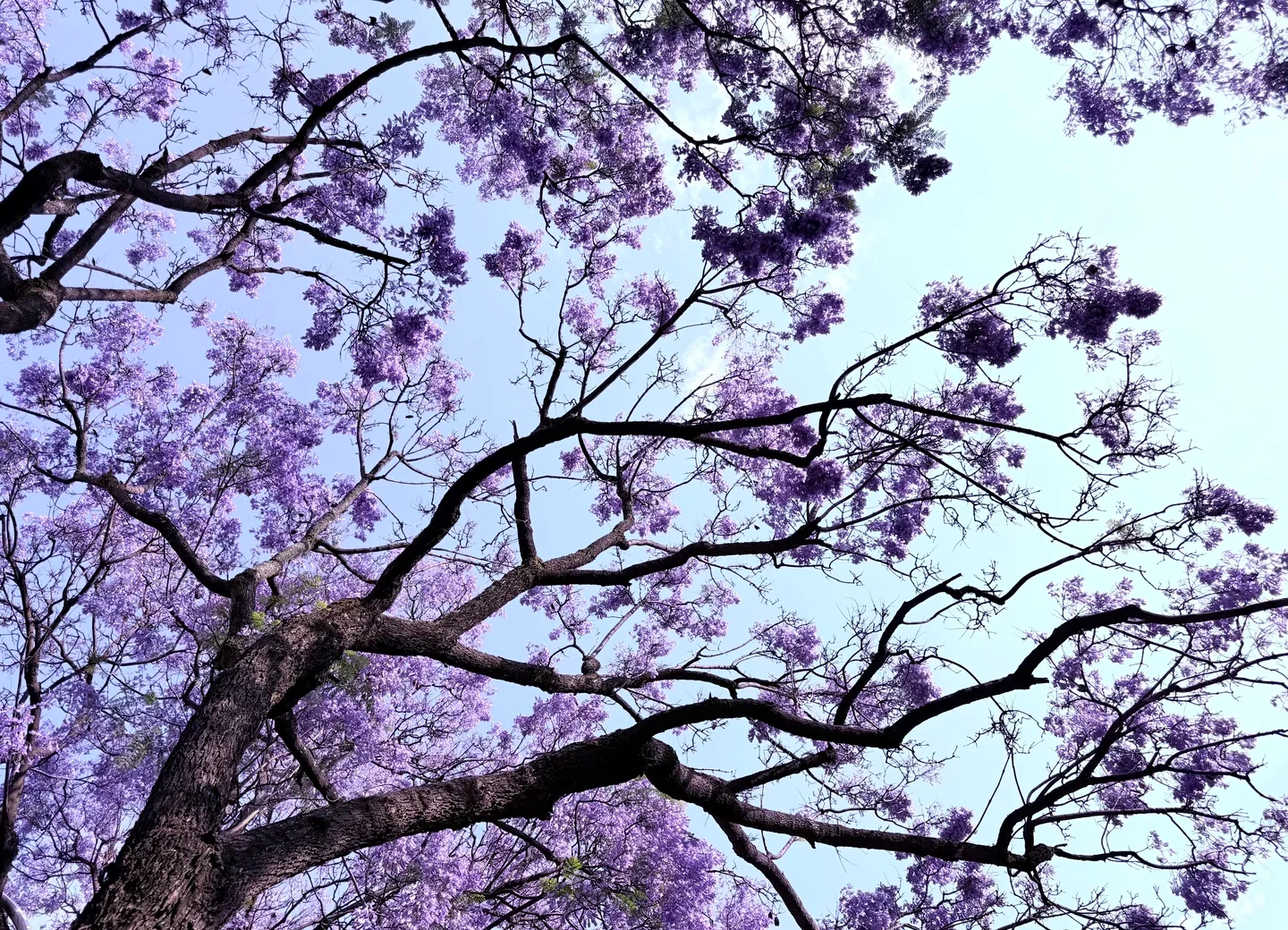
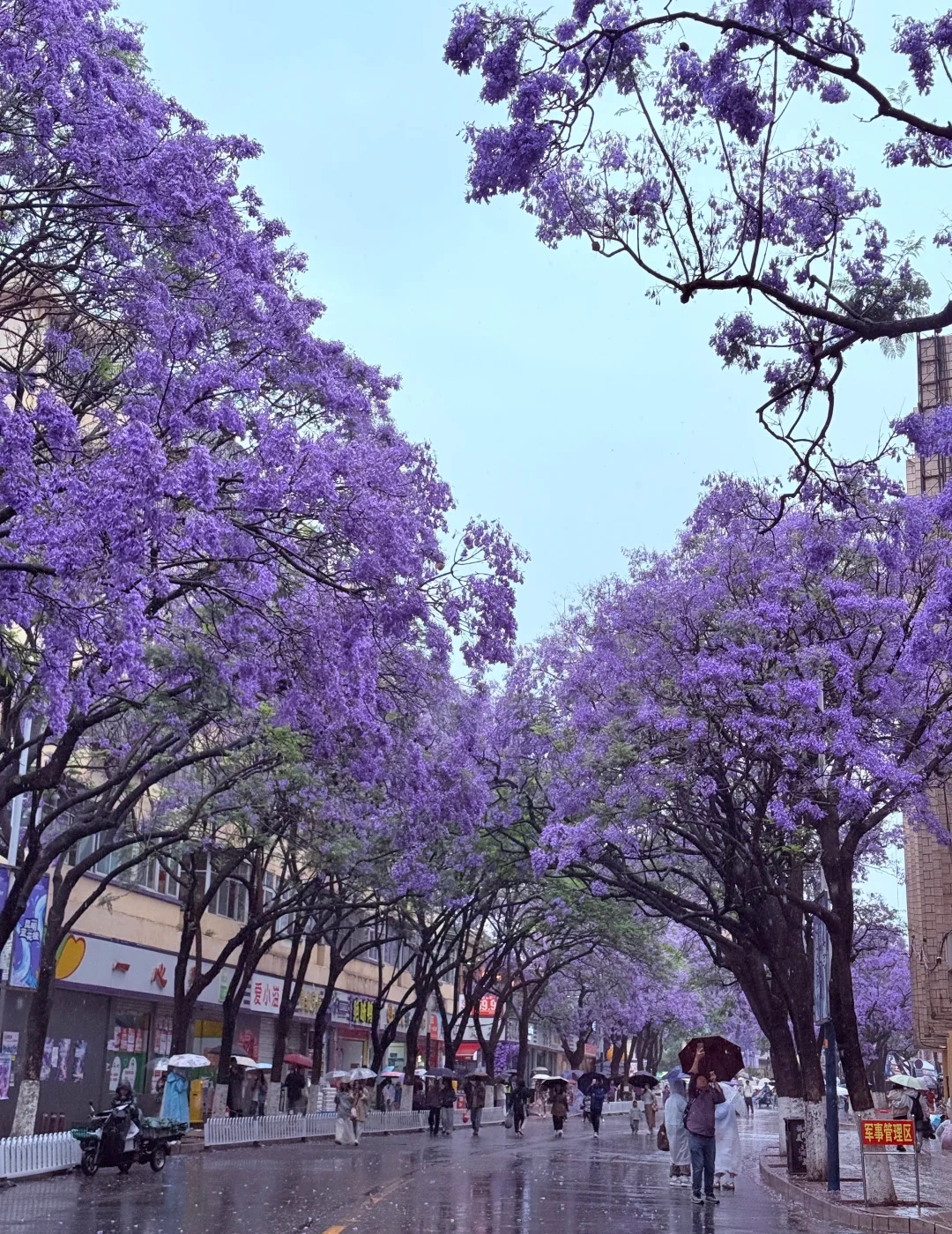
The photograph shows the flowering canopy on Jiaochang Road / 教场路, from an account edited on 5 May. The writer describes intermittent rain during the holiday before a sunny final day.
A local report on 29 April 2026 described Kunming’s late-April-to-May jacaranda display. A 29 May field report, quoting the city landscaping authority, placed that year’s main bloom at roughly 20 April to mid-May.
Those dates describe 2026. I would use them to choose a starting window, then refine a flower-led trip by the actual year’s progress. A photograph of one splendid tree is not a citywide bloom forecast.
Mid-April can mean a few flowering trees, rather than the whole street
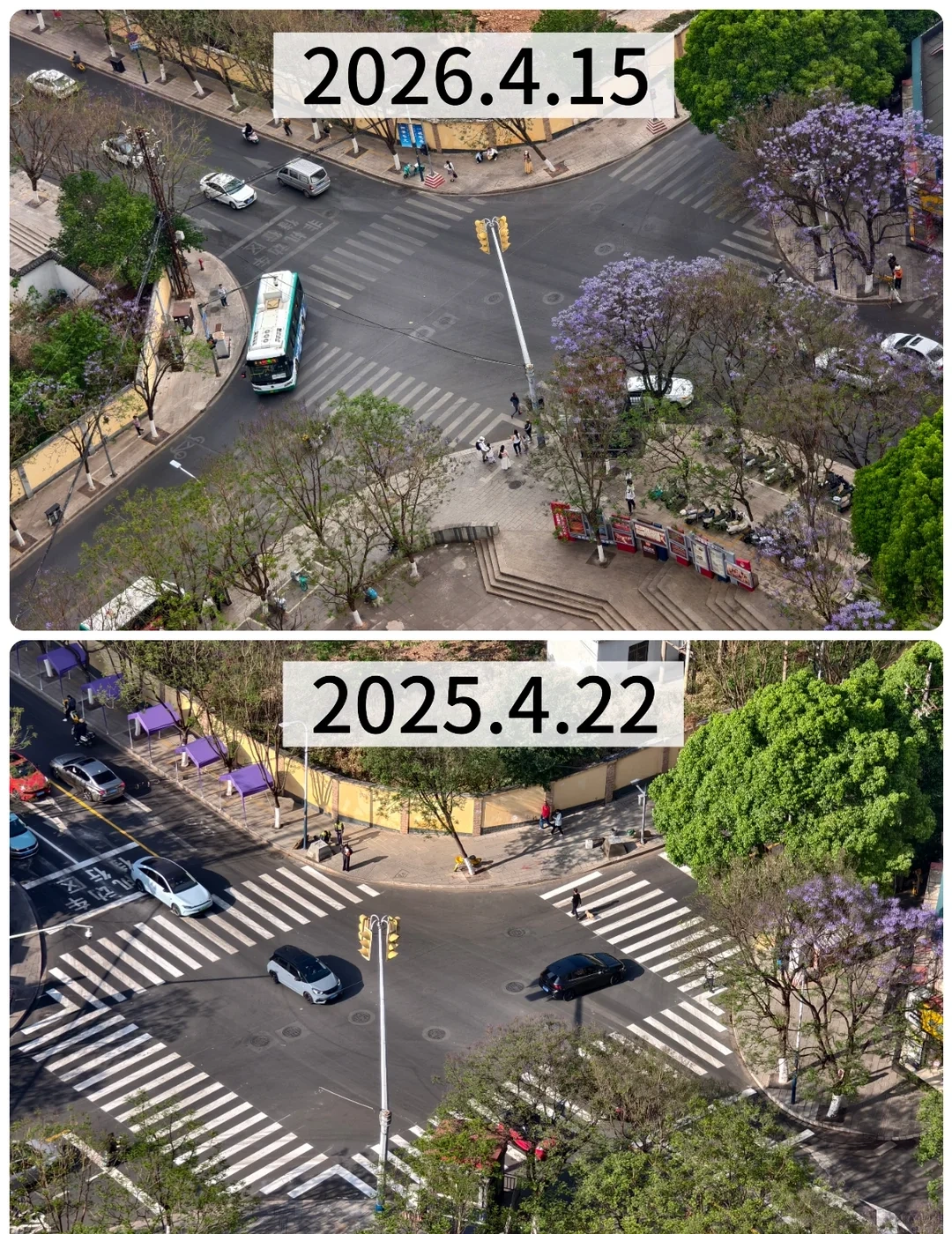
This photographer’s comparison is explicitly labelled 15 April 2026 above 22 April 2025, at Jiaochang Middle Road / 教场中路. The 2026 frame shows some purple crowns beside trees that are much less advanced.
The author described four or five trees flowering well and thought the season was earlier than the year before.
That helps explain why “the flowers have started” and “the street is at its best” are different reports. It also explains the mixed reactions beneath some popular April posts: visitors can see different trees or arrive at a different stage.
I would keep a mid-April visit flexible about the amount of purple. The two dated views illustrate variation; they do not independently measure a precise ten-day shift across all Kunming trees.
A flowering May street can still be wet and cold-feeling
The account titled “5.3 Jiaochang Middle Road” shows umbrellas, wet paving and jacaranda flowers overhead. Its short caption says the rain felt cold. The visible edit date is 4 May.
This is a useful companion to the sunny canopy above. The same broad flowering period can offer very different days.
I would choose this window for the flowers while leaving room for wet weather, rather than making blue sky part of the promise. The author’s cold experience is a personal account, not a measured temperature.
The umbrellas and wet ground are visible evidence of the conditions in this scene. They do not mean all May days are rainy, or that a holiday’s last day will reliably be sunny.
A late-May tree is an exception worth distinguishing from peak season
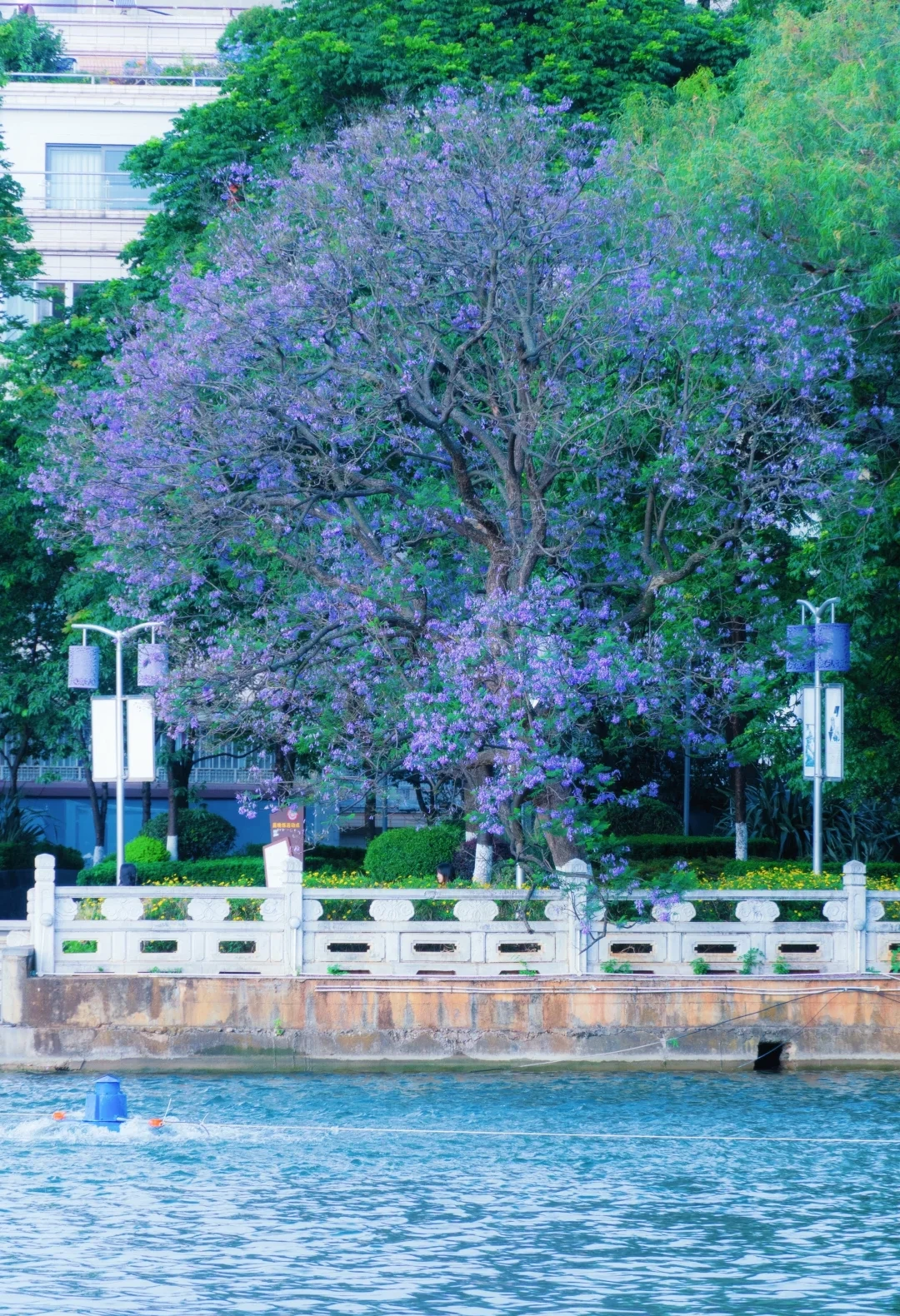
The Green Lake / 翠湖 photograph below comes from an account explicitly titled 28 May, posted on 31 May. The author says this particular jacaranda usually flowers late.
Purple clusters remain among a substantial amount of green foliage. It is a different prospect from planning around an entire purple street.
The citywide field report published 29 May 2026 described the main season ending and many locations already dominated by leaves.
If late May is fixed, I would regard an individual late tree as a possible bonus. I would not book that week expecting the same dense display seen in early-May photographs.
Summer is mild in the averages, but much wetter
For fixed summer dates, the central trade-off is rainfall. The station normals give June 177.4 mm, July 216.6 mm and August 196.1 mm, alongside monthly mean temperatures near 20–21°C.
By comparison, March has 20.1 mm, April 27.3 mm and November 30.6 mm. October remains wetter at 80.8 mm. Calling all of autumn “dry” would hide that difference.
I would keep summer in consideration if the cooler city climate appeals and rain would not ruin the trip. For a short visit whose success depends on dry outdoor photography, the lower-rainfall months offer a more suitable starting point.
Monthly totals do not tell us how many hours it will rain on your dates. A wet-season total also does not mean continuous rain every day.
Winter light is appealing, while the city remains cool
This sunlit lake scene belongs to a Haihong Wetland collection shared on 11 January. Gulls fly above choppy water as the sun sits low behind the hills.
It is a strong reason to consider the winter season. It is also a photograph of one moment, with no temperature reading attached.
The winter station means are around 9–10°C. I would compare a winter Kunming trip as a cool city break with a seasonal wildlife attraction, rather than imagine that a golden sunset makes it a warm beach holiday.
The author gives an approximate sunset window in their account. Sunset varies by date, so this photograph is not an all-winter timetable or a guaranteed clear evening.
Match the seasonal priority to the correct holiday year
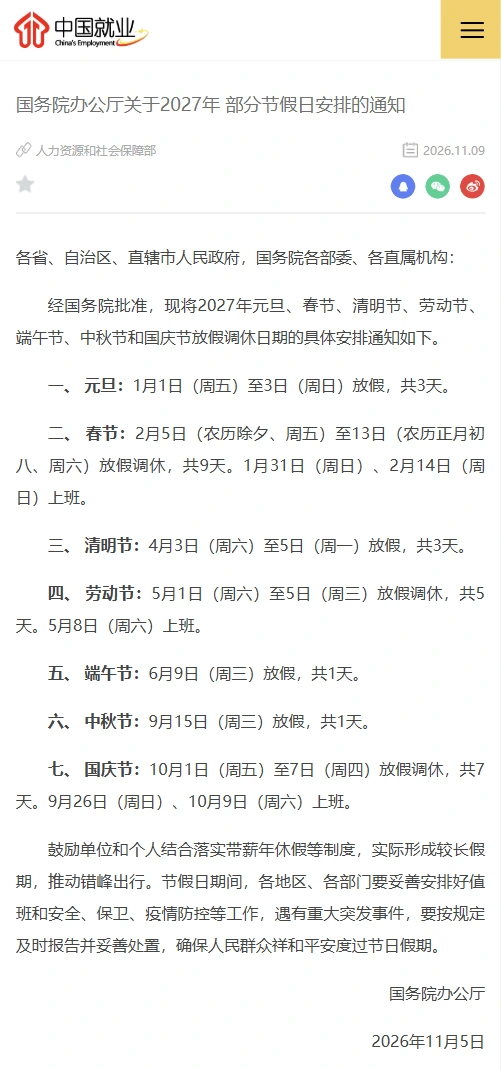
For 2027, the mainland holiday calendar lists Qingming on 3–5 April and Labour Day on 1–5 May. Those dates matter when comparing spring options, especially when a flower window overlaps early May.
Winter visitors have 1–3 January and 5–13 February to compare for New Year and Spring Festival. National Day is 1–7 October.
I would compare the actual holiday dates with the scenery I want, rather than choose a season from the name of a festival. Early May can coincide with jacaranda season; a different holiday may not.
The calendar gives public holidays. It does not predict crowds or hotel prices. The road controls in the April 2026 flower report belonged to that year’s holiday; they are not 2027 access instructions.
Finish with the printed date and the Kunming urban forecast
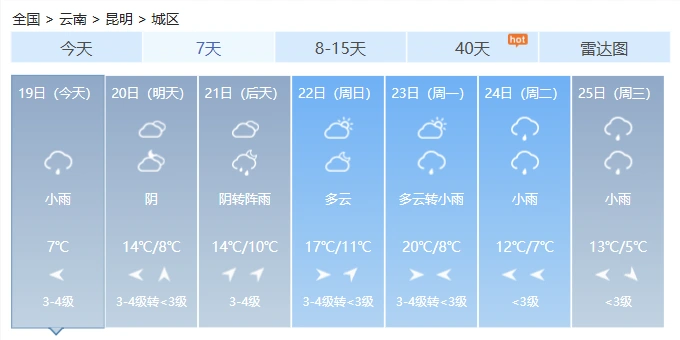
The Kunming urban forecast below was captured after midnight on 20 November 2026, while the relative labels still called the 19th “today” and the 20th “tomorrow”.
The printed 20日 column gives 14°C / 8°C, 阴 — overcast. The printed 21日 gives 14°C / 10°C, 阴转阵雨 — overcast changing to showers.
The location reads 昆明 → 城区: Kunming’s urban area. The single 7°C in the printed 19th column is the remaining overnight forecast, not that day’s daytime high.
This is how I would finish the date choice: the right season for the scene, the actual holiday year, and the forecast for the place and days being visited. The gull photographs explain winter’s appeal; this overcast forecast shows why a real trip still needs flexibility.
Your dates should match the scene that matters most. A general city visit, a gull-focused winter trip and a jacaranda trip lead to different shortlists.
A finished choice identifies the priority, the amount of wet or cool weather you are comfortable with, the correct holiday year, and the forecast for the actual place and days. If late-May dates are fixed, treat a late-flowering tree as a bonus; if summer dates are fixed, allow for the wetter climate rather than reject the city simply because it is summer.
Checked 20 November 2026. Station normals use 1991–2020. The detailed jacaranda report describes the 2026 season; future peak dates can differ. The holiday calendar is for 2027. Individual photo dates are qualified in the captions. Source colour treatment is retained. No personal visit is claimed.
Questions and updates
Comments may be reviewed before they appear.
Your comment and chosen name may be published. We store your IP address and browser details to help moderate comments.