
China Time Zones: Beijing Time, Train Times and Xinjiang
For mainland China train travel, the clock to follow is Beijing Time / 北京时间: UTC+8, using the 24-hour clock. Moving from Beijing to Shanghai or travelling west does not, by itself, mean subtracting hours from a railway departure.
Xinjiang is where an extra question matters. Xinjiang Time / 新疆时间 can mean UTC+6, while people also describe later daylight and daily routines as a “two-hour time difference”. Those are different ideas.
The real query screenshot and clock examples below separate the cases: train departures, quoted Xinjiang times, international flight dates and calls to a country with daylight saving.
For mainland travel, begin with Beijing Time: UTC+8
Beijing Time / 北京时间 is the national standard-time reference, UTC+8. For an ordinary mainland city-to-city trip, a change of city does not itself require a different Beijing-time clock.
The Civil Aviation Administration’s explanation of standard time describes this nationwide reference. The current IANA time-zone record represents the Beijing-time convention with Asia/Shanghai. “Shanghai” in that identifier does not mean Shanghai runs on a different clock from Beijing.
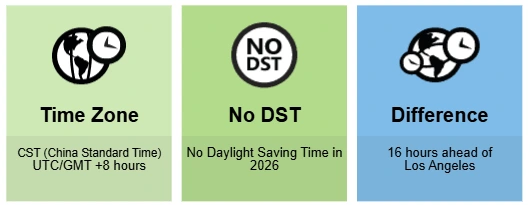
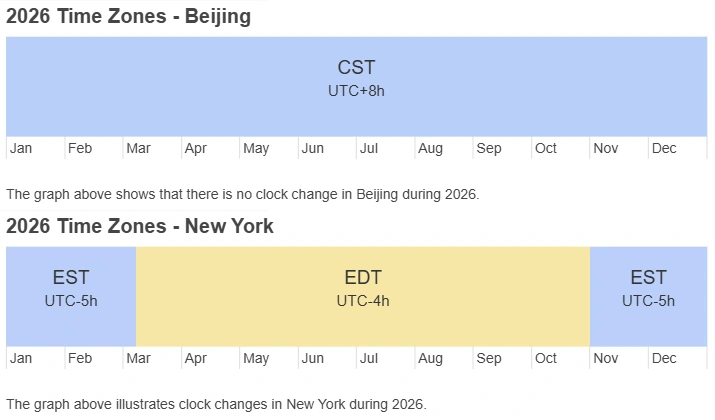
The actual Beijing clock-page excerpt below labels it China Standard Time and UTC/GMT +8 hours. It also shows no daylight-saving change in 2026.
Xinjiang needs one extra distinction: local conversation can use a different convention. That does not change the clock standard on a mainland train record.
Read a mainland train time as Beijing Time in 24-hour format
The railway passenger regulations define time as Beijing Time, counted from midnight, using the 24-hour clock. The same definition appears in the desktop version of the rules.
This real, archived query screenshot shows D70 from Urumqi / 乌鲁木齐 at 14:50 to Hami / 哈密 at 18:54. Its displayed duration is 4 hours 4 minutes.
Here, 14:50 means 2:50 pm Beijing Time; 18:54 means 6:54 pm on that same clock. There is no two-hour Xinjiang correction to subtract from the displayed railway departure.
The row is a reading example from a post edited on 23 September. It does not establish today’s departure or fare. For an actual journey, the dated ticket’s departure is the relevant record.

Separate Xinjiang Time from later daylight and later routines
The phrase “Xinjiang is two hours behind” can hide two different ideas. One is that daylight and daily routines happen later on a Beijing-time clock. The other is a clock convention called Xinjiang Time / 新疆时间, which is UTC+6.
The IANA record distinguishes Asia/Shanghai at UTC+8 from Asia/Urumqi at UTC+6. A phone or app’s city label alone therefore does not explain which convention another person means.
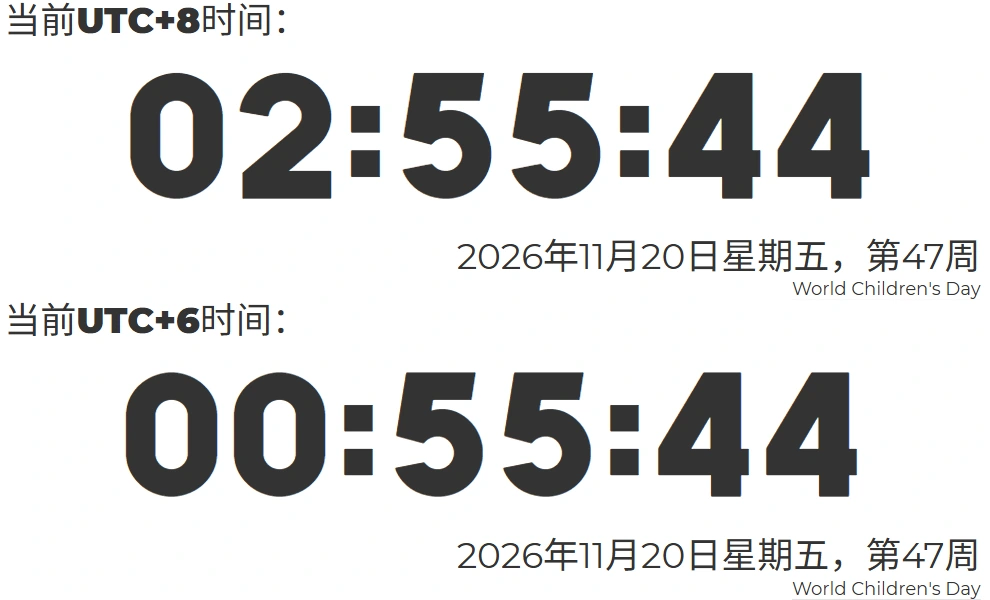
The two actual offset-clock captures below make the arithmetic visible: 02:55 at UTC+8 corresponds to 00:55 at UTC+6. They are dated examples, not live clocks embedded in this article.
For a personal meeting, a useful clarification is “北京时间,还是新疆时间?” — “Beijing Time, or Xinjiang Time?” As a calculation example, 10:00 Xinjiang Time means 12:00 Beijing Time. A confirmed clock standard resolves that ambiguity; the railway rule above still governs the train record.
The clock and the look of the morning are different questions
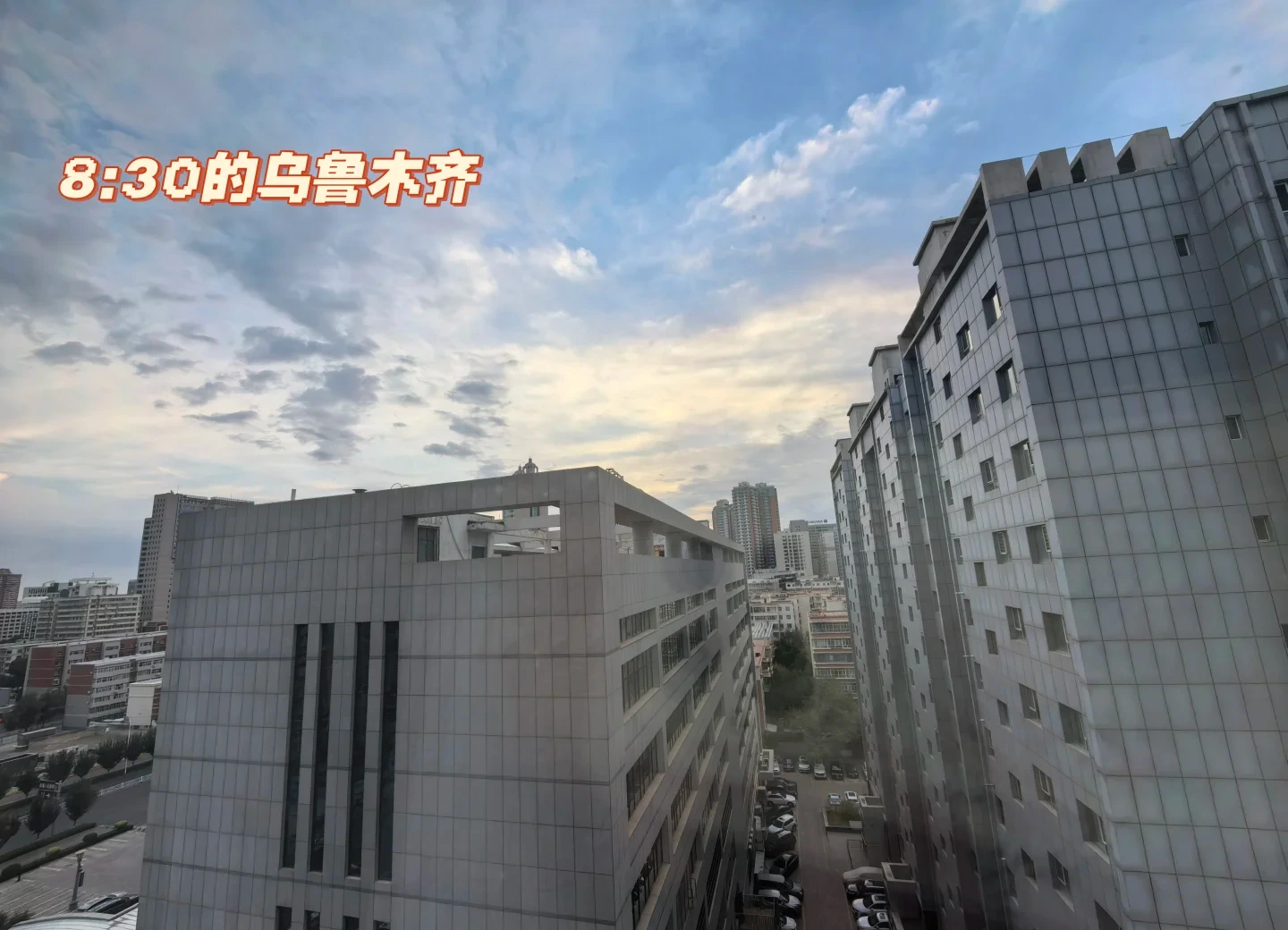
The photographer labels this image “8:30的乌鲁木齐” — Urumqi at 8:30. It shows a pale, cloud-filled sky above city buildings in an account shared on 24 September.
The visitor describes being struck by how the morning looked compared with their expectations. That is a useful travel observation, rather than a measurement of sunrise or proof of a different official clock.
I would separate the two questions when planning: what time does the ticket or appointment mean, and what will the daylight be like at that place and date? The first needs a clock standard. The second depends on location and season.
A photograph of an early-looking sky is not a reason to shift a train departure by two hours.
A late-looking summer evening is not a year-round sunset timetable
This Xinjiang street sunset comes from a reflection dated 30 July 2026 within a post shared on 19 October. Street lamps are lit while warm colour remains along the horizon.
It belongs with the writer’s summer description, rather than being evidence of October daylight at a stated hour. The exact time and location of this individual frame are not confirmed.
Late summer-evening light helps explain why visitors describe eating or going out later on a Beijing-time clock. It does not establish one sunset hour, one restaurant schedule or one bedtime for the whole region throughout the year.
For a time-sensitive plan, a quoted clock time needs its standard; the daylight question needs the actual place and date.

On an international timetable, local times and “+1” both matter
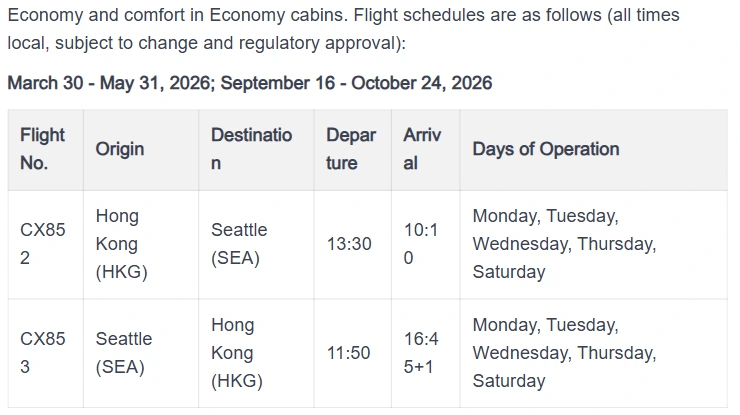
An international flight table can use a different local clock at each end. The Cathay Pacific example below explicitly labels its times as local.
In the displayed historical schedule, CX853 leaves Seattle at 11:50 and arrives in Hong Kong at 16:45+1. The departure is Seattle local time; the arrival is Hong Kong local time. +1 means the following calendar day.
It does not mean a five-hour flight, and it does not mean adding one hour to 16:45. The displayed clock times belong to different places, and the arrival date has moved on.
The publisher’s row wraps the arrival across two lines; read the full field as 16:45+1. This announcement was published in September 2025 and the pictured table covers specified periods in 2026. It is a notation example, not a current flight offer or confirmed itinerary.
China’s clock can stay fixed while your home-time difference changes
Beijing Time remains UTC+8 under the current rules. The upper 2026 chart below shows that unchanged offset across the year.
The lower chart is New York. It changes between EST at UTC−5 and EDT at UTC−4. That makes Beijing 13 hours ahead of New York during EST, and 12 hours ahead during EDT.
These differences come from the offsets: +8 minus −5 is 13; +8 minus −4 is 12. China has not moved its clock in that comparison — New York has.
For a call home or an overseas appointment, the useful comparison includes both places and the actual date. One remembered number is not a year-round rule for every country. The Beijing and New York records show the distinction.
Use “Beijing Time, UTC+8” when “CST” could be misunderstood
In this guide, CST means China Standard Time. The same abbreviation is also used for a different standard time in North America.
The IANA documentation explicitly points out that ambiguity. For an international conversation, “Beijing Time, UTC+8” is clearer than “CST” by itself.
A complete time statement has a date, clock time and standard. A mainland train adds its actual departure record; a personal meeting in Xinjiang needs the quoted convention confirmed; an international flight adds the local place and any next-day marker.
That is the useful result: the same written number no longer leaves you guessing which clock, which place or which day it belongs to.

A clear plan states the date, the clock time and the time standard. For a mainland train, the displayed departure uses Beijing Time and a 24-hour clock. For a personal meeting in Xinjiang, the meaning of the quoted time needs confirmation.
For an international flight, each end can use its own local clock, and “+1” advances the arrival date. For an overseas call, daylight-saving changes at the other end can change the difference from China.
When an abbreviation could cause confusion, “Beijing Time, UTC+8” gives the reader or the person you are meeting a much clearer reference.
Checked 20 November 2026. Offset-clock captures and 2026 charts are dated illustrations, not live clocks. Train and flight rows are historical reading examples, not current availability. Visitor photo annotations are retained; the sunset reflection’s date and later post date are distinguished. No personal visit, purchased ticket or phone configuration test is claimed.


Questions and updates
Comments may be reviewed before they appear.
Your comment and chosen name may be published. We store your IP address and browser details to help moderate comments.